"Since flesh can't stay, we keep the breath aloft. Since flesh can't stay, we pass the words along." --Erica Jong

Tuesday, July 11, 2006

Little Boy Blue


The little toy dog is covered with dust,
But sturdy and staunch he stands;
And the little toy soldier is red with rust,
and his musket moulds in his hands.
Time was when the little toy dog was new,
And the soldier was passing fair;
And that was the time when our Little Boy Blue
Kissed them and put them there.

"Now don't you go till I come," he said,
"And don't you make any noise!"
So, toddling off to his trundle-bed,
He dreamt of his pretty toys;
And while he was dreaming, an angel song
Awakened our Little Boy Blue--
Oh! the years are many, the years are long,
But the little toy friends are true!

Ay, faithful to Little Boy Blue they stand,
Each in the same old place--
Awaiting the touch of a little hand,
The smile of a little face;
And they wonder, as waiting the long years through
In the dust of that little chair,
What has become of our Little Boy Blue,
Since he kissed them and put them there.

--Eugene Fields

I had memorized this poem from one of my books by the age of five. I loved it, I loved the picture that illustrated it. A book I have now lists it among other inferior poems because it is sentimental. "It oversimplifies," says the book. "It is unfaithful to the full complexity of human experience. It aims primarily at stimulating the emotions directly rather than at communicating experience truly and freshly; it depends on trite and well-tried formulas for exciting emotion; it revels in old oaken buckets, rocking chairs, mother love, and the pitter-patter of little feet."

Well, okay. It may not be listed among the very greatest of poems, but it was just right for a five-year-old who was still very into rocking chairs and mother love.

Thursday, June 22, 2006

Tumbleweeds


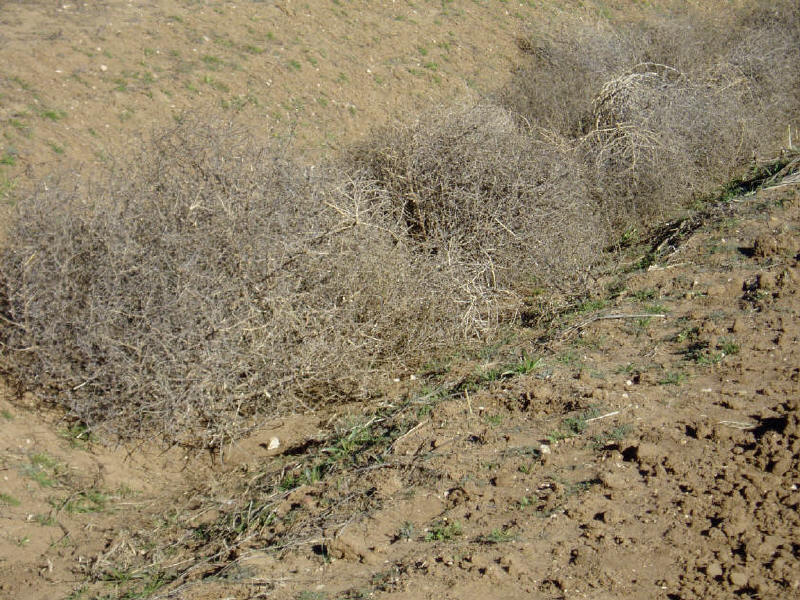
When I was a child, I would curl up in bed under three blankets, covering my ears against the wind howling outside. We could tell, by wind-clouds piling up along the tops of the Sierra-Nevadas, when there would be a big blow. The wind always came from the west, blowing sand into waves of dunes in the front yard, settling a fine, thick silt on the window sills and in the corners. It made spooky howling noises in the stovepipe and the clanging of the chains on my swingset against the bars kept me awake all night. As I looked out my bedroom window, the red light from the Penny Arcade sign across the street bloodied every grain of sand, turning the whole window red. Sand blasted the paint off cars and pitted windshields, and blotted out the sun. It stung our eyes and textured our dinner and turned tumbleweeds into flying missiles.

Once, the circus came to town in the middle of a terrific windstorm. Their Big Top swayed and groaned, the ropes and posts and canvases snapped like ships in the blowing sand. The daring young men on the flying trapeze may have been daring, but they were not fools, so they stayed safely on the ground while their swings billowed and lifted without them. Still, we saw monkeys (One, wearing a little red coat with gold buttons, bit my finger, outstretched in friendship. I never tried that again!) and elephants, lion-tamers and clowns. We saw Bambi-the-Snake-Woman, and Bobo-the-Dog-Faced-Boy. The Man-Turned-to-Stone invited our hands to feel the vibrations on his leg while he spoke. A nine-foot giant mummy, leathery and brown, reclined in a wood-and-glass case. Beside him in a smaller case there was another mummy of an ancient infant that looked like a little shriveled, brown monkey. We ate pink spun-sugar cotton candy, and shiney, red candy apples-on-a-stick.

And I remember once, Gypsies camped their tents and wagons at the far end of our lot. Someone said Gypsies stole children, dyed their skins brown with the juice of berries and walnuts, and they had to be Gysies for the rest of their lives. I lived in
horror they might kidnap me, yet I secretly hoped they would, so that I could live a life traveling in tents, wearing gold earring and bracelets up to my elbows, and dancing to the music of tambourines. However, I took the long, round-about way to school for as long as they camped there. I never heard one tambourine. The closest I ever came to living like a Gypsy was years later when I travelled around the country with a theater reperatory troupe--in a tan station wagon overflowing with old show programs, candy wrappers, banana skins, etc., and we made our own peculiar music (of a sort). In school every morning, the teacher gave us mimeographed pictures to color of Farmer Brown, Farmer Brown's Wife, and Farmer Brown's Boy Bill. (Never once Gypsies!)

I remember the hills and gullies full of sage and creosote and cactus, coyotes and rattlesnakes and lizards. When more and more people began to move in, they all vanished. The shrill night howling of coyotes used to send shivers of fear up and down my back. Now most of the remaining coyotes are pacing up and down in zoos, although the sheepmen say some still attack and kill their sheep. I suffer with the sheep, but my heart is with the coyotes. I think the whole history of creation is in those sheep and the coyotes.

Tuesday, June 20, 2006

Grandpa in Flowers


For tho' from out our bourne of time and place
the flood may bear me far,
I hope to meet my pilot face to face
when I have crossed the bar.

--Tennyson


James William Hatton
12/14/1878 - 12/13/1944

SO IT GOES!


I like to think of people as Kurt Vonnegut's Tralfamadorians saw them in Slaughterhouse Five,--as continuous beings not unlike long caterpillars, with fat baby's legs at one end, and long, ancient legs at the other--beings forever all-one-piece, integrated and entire. Vonnegut's Tralfamadorians, seeing into the fourth dimension, perceive the universe in a radically different way:

"All moments, past, present, and future, always have existed, always will exist. The Tralfamadorians can look at all the different moments just the way we can look at a stretch of the Rocky Mountains, for instance. They can see how permanent all the moments are, and they can look at any moment that interests them. It is just an illusion we have here on Earth that one moment follows another, like beads on a string, and that once a moment is gone it is gone forever.

"When a Tralfamadorian sees a corpse, all he thinks is that the dead person is in bad condition at that particular moment, but that the same person is just fine in plenty of other moments. Now, when I myself hear that somebody is dead, I simply shrug and say what the Tralfamadorians say about dead people, which is 'So it goes!'"


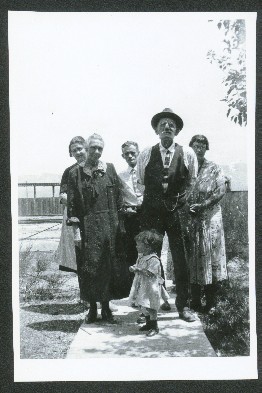
So it goes. I am five-years-old, and they have taken me to say "goodbye" to my grandpa, who is sleeping in flowers, but he doesn't wake no matter what is said to him.

Then I am six-years-old, having another encounter with Vulture Death. I hold a brown leather dog collar. Topper was a good dog, now he is dead, run over by a truck. The truck meant no harm. The driver was sorry, and he said so. I think of all the uncounted dogs and cats and birds that died somewhere back in my childhood: Sparky and Cue-Ball, Topper, Lucky, Penny and Bobby, blue and green parakeets, Monday the sparrow, Perry the chipmunk....a boxfull of naked pink baby mice someone found in an old trunk and brought to me. Another sparrow we named Frosty. Toots, and Queenie, the last dogs of my childhood. When Topper died, for weeks afterward the very air smelled of him. He was nowhere and everywhere. And every loss brought floods of tears. When Lucky died I wrote my first poem:

There is no more puppy
to laugh with, or play.
There is no more puppy
to care for each day.

There is no more puppy
to come when I call,
there is no more puppy,
no puppy at all.

Well, it's not Shakespeare, but what d'you expect? I was eight.

Back to Vonnegut's caterpillar. I am six again, watching snakes climb up the gray folds in the window-curtains, hearing the old photographs on the walls whisper to one another of times past in quiet, paper voices. My heart thumps monstrously loud.

Whatever happened to Baby Dumpling, and the rocking chair, and all those pop bottles full of sand? Nicodemus had no shoes, so who was it stepped in all the pies? Jesus loves me, this I know. I'll be a sunbeam for him. I love Jesus. I love cats. Cue-Ball is my cat. He rides in the little buggy and sings. A sunbeam, a sunbeam, Jesus wants me for a sunbeam. Loves. By pinching is how people who love each other very much get babies.

I was stunned when mother told me how people do get babies. "Do you remember that word I told you not to say?" Mother must have been acutely embarrassed. "That's what people do." She never said the word, but that was my sex education. I knew those bizarre activities occurred, whatever they were called. But I could not imagine why anyone would want to do such things, and certainly, if they did, it didn't concern me. We never talked about "it" again.

So it goes!

Wednesday, June 14, 2006

THOSE TIMES


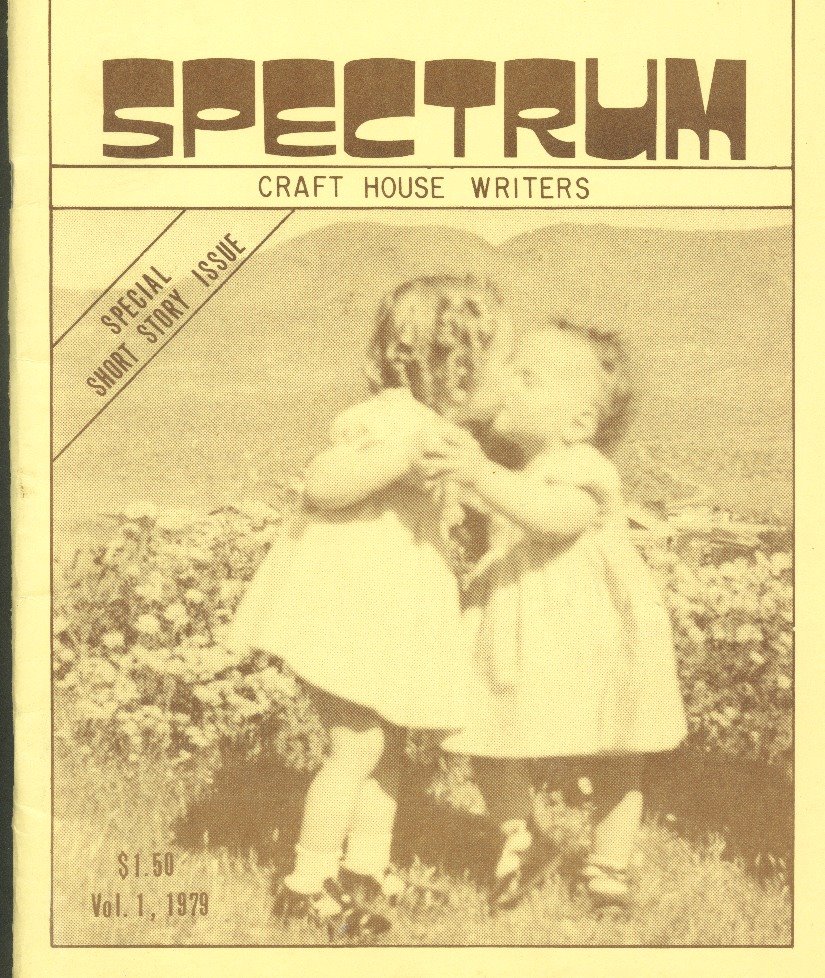
Diane and me, in wildflowers. Riding in a baby carriage, being angry, bawling that my friend Diane (being littler) was sitting comfortably in the shade of the hood while I was at the end, in the sun. The carriage was being pushed by someone named Virginia.

Riding on my dad's shoulders down the hill in the dark to get ice-cream, and returning home to find Santa Claus had come. He left a set of little blue plastic dishes, and my beautiful Baby Sunshine baby doll. She was also called, sometimes, Baby Dumpling--(after the real baby of a friend of my mama's--actually, Blondie and Dagwood's first baby Alexander was called 'Baby Dumpling,' so that's where it all started, in the funny papers!)

Playing with my mother's old dolls, a blue celluloid baby (which I left outside to be ruined--(all her arms and legs fell off), and another of her dolls which I loved, with a china head, real hair, and a smile with real teeth--(which I also left outside for the dog to ruin). She was my mother's, when she was a little girl. The doll's name was 'Norma,' and she still resides (her china head glued back together) in a box in my attic.

I remember playing in Bacopickle's garden, the fence, the hollyhocks. I always carried a big smooth oval rock around, pretending it was my 'baby.' John, Bacopickle's husband (but never my 'grandpa') once sent me a letter (an exciting thing!) telling me to 'be a good girl,' and to 'go sit on a tack,' or maybe it was 'don't sit on a tack.' Whichever, I was pleased and thought it was funny. John always called me "Blondie."

A watermelon 'bust' at Dry Lake. My cousin Jerry and I kick sand on the campfire to put it out. The big people heap praises upon us. We kick more sand on the fire. I am going to marry Jerry. Jerry kicks a big desert turtle on the top of its shell with the heel of his boot. How mean! I am not going to marry Jerry after all.

My brother's black dog, Sparky. My brother jumping over a fence, followed by Sparky. I remember looking for Sparky after he was poisoned, suspecting that he was buried under a red hill of dirt in the yard, digging to find him.

My old black-and-white tomcat, Cue-Ball. I dress him up in doll clothes and haul him around in my wicker doll-buggy. He is docile and loving and content. He lays on his back and purrs, wrapped in a little blanket. Sometime later, I am sitting on my Grandma Bacopickle's lap in the big rocker. Cue-Ball is on my lap, purring, his claws pushing in and out like cat's do when they're happy. One of his claws catches a big scab already on my knee and pulls it off. The knee becomes infected, and we go to see Dr. Drummond (the doctor who delivered me), where his pretty nurse, Cherry, fixes me up with a new bandage. I remember my crib, metal with white, peeling paint. Every time I walked by it I knocked the scab off my knee! I slept in the crib until I was four or five.

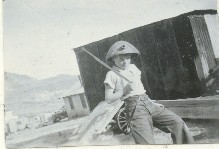
I remember going on vacation, a picnic of sorts. I need to go potty and I'm taken out to a private wooded place. Later on, I discover my privacy was invaded--someone took my picture! I feel betrayed and humiliated. I am enraged and embarassed seeing these two photographs, "hoarding my small dignity," as Anne Sexon wrote in a poem called THOSE TIMES.

We are in Whitney, Nevada, where my dad is thinking of buying a store with my Uncle Leffel. I find a nest of kittens, one dangling by its neck between two shelves under a counter. In Whitney, I make a 'cradle' of my hands to rock a tiny baby turtle, (a fingerplay mama taught me): Here are mother's knives and forks, here is mother's table. Here is sister's looking-glass, and here's the baby's cradle. We leave Whitney after a short time and come back to California. (My brother, who was 14 at the time, informs me that there was a big magnesium mine that opened up, and since it was wartime, there was a great demand for magnesiuim. Dad and two of our uncles, Leffel and Ray, thought a store would be a good idea. We stayed there for only six months, so it probably wasn't.)


Someone holds me up to peer over a high fence where a little girl who has no arms plays. They tell me how she can feed and dress herself, and write, anyway, with her toes. I am impressed. Someone holds me up to a window, where a sick girl named Yvonne is darkly quarentined behind a screen. Say "Hello," I am told. "Hello," I say, but I feel something dark inside my chest that I can only equate now to Defoe's Journal of the Plague Year.


The sound tin cans made when they were scraped in the sand. Filling up empty bottles with the sand, patting it down flat when they were full. The taste of sand, the wonderful smell of it. Pouring it out, and scooping it up again.

Making 'pets' out of the little white balls of fuzz that grew on the creosote bush beside the house. In the summer, they turned, like dandelions, into tiny yellow flowers. The smell of wildflowers in the spring. The hillsides were covered with wildflowers.

The tobacco-smell of my grandpa. The powder-smell of Nanny.

Outhouses. Grandpa and Nanny had a seat with a lid on theirs. Ours was just a hole in a board. My little potty chair inside, by the ice-box. My little rocking chair.

My butcher-boy outfit with flowers embroidered across the front. My coat with little buttons shaped like deer.

The 'bean' tree in our yard, a locust tree, I think. I gathered the long, thin green pods and 'cooked' them.

I remember seeing a movie cartoon where Mickey Mouse cut a loaf of bread into slices so thin they were transparent. You could see the knife passing through.

Biting the skin on my mother's elbow because it felt so good to my teeth. --Never hard enough to hurt, but it must've been really annoying to her....

Misunderstood! I am standing in the front seat of the car, between Mama (who is driving) and Mrs. Lambly, (who is all dressed up) and who has white hair and shiney dangling earrings. I admire her earrings, am about to touch them, when mama scolds me, tells me to "stop it." I realize that she thinks I will pull them through the piercings in the lady's ears. My feelings are hurt that she thinks I'd do something so stupid. I just thought they were pretty things, and I was going to tell her so.

The rusty water towers on the hill above our house. The silver milk cans in the barn. The way the cream wrinkls on top of the milk.

Rinaldi's Meat Market; It smells of the thick sawdust covering the floor, ankle-deep, and of salt. I like to come here with my mother. The earthy smells of the mine shafts daddy works in, of the burning carbide in the miners' lamps, of cool wet rocks.

All of these before I was five, before we moved away from Red Mountain.

Sunday, June 04, 2006

THE BOMB

Praise The Lord


And Pass the Ammunition


Down went the gunner; a bullet was his fate,
Down went the gunner, and then the gunner's mate.
Up jumped the sky pilot, gave the boys a look
And manned the gun himself as he laid aside the Book,
Shouting: Praise the Lord and Pass the Ammunition!
Praise the Lord, and Pass the Ammunition!
Praise the Lord, and Pass the Ammunition,
And we'll all stay free!

Praise the Lord, and swing into position,
Can't afford to sit around a'wishin'.
Praise the Lord, we're all between perdition
And the deep blue sea!

Yes, the sky pilot said it. You've got to give him credit,
For a son-of-a-gun of a gunner was he, shouting:
Praise the Lord; we're on a mighty mission,
All aboard! We're not a'goin' fishin'.
Praise the Lord, and Pass the Ammunition,
And we'll all stay free!


Words and Music by FRANK LOESSER

WW2, Three Musketeers


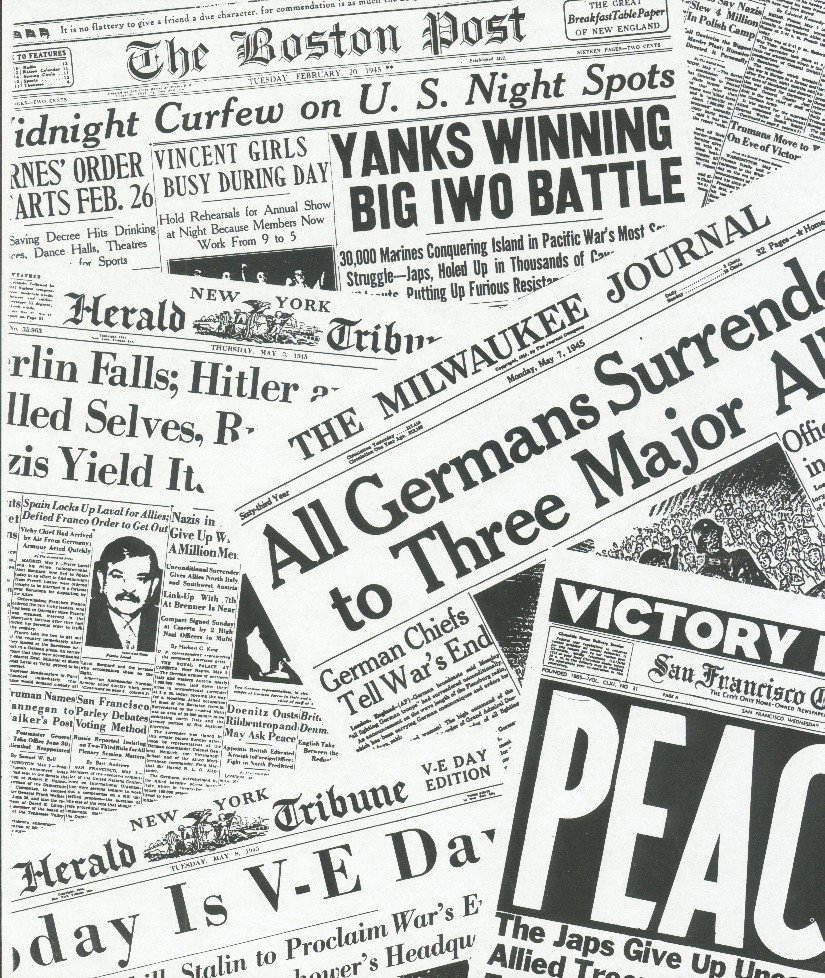
On December 7, 1941, the Japanese bombed Pearl Harbor Naval Base in Hawaii in a surprise attack, killing some 3,000 Americans. I actually remember people weeping, whispering those words, "Pearl Harbor!" Within days, young Americans flocked to enlist in the service, among them my dad's curley-headed brother, my Uncle Rulon. He spent most of the war years in (of all places), Iran. Daddy joined the Coast Guard. Tommy Dorsey recorded "Kiss the Boys Goodbye." The Andrew Sisters sang about the "Boogie Woogie Bugle Boy." In the years that followed, clocks were turned ahead one hour as "war time," now called Daylight Savings Time, went into effect. Gasoline, sugar, and butter were rationed. People carried little packets filled with "tokens," little round brown things that could be spent as money. Mama filled plastic trays with a white margerine and poured in little packages of yellow dye to make it look like real butter. Even the movie stars went to war. Clark Gable, Jimmy Stewart, Gene Autry, Spencer Tracy, and Douglas Fairbanks joined up, while glamorous women stars asked us to buy war bonds. "Praise the Lord and Pass the Ammunition" was number 1 on the Hit Parade. I stood on some piano bench, somewhere, and sang it to much applause. (The end of my singing in public, I might add!) Mama sang in the kitchen, while fixing dinner and doing dishes, she sang as she made the beds, and swept the floors. Ac-cent-tchu-ate The Positive, E-lim-i-nate the negative. Don't Get Around Much Anymore. I'll Never Smile Again. I'll Be Seeing You in All the Old Familiar Places. The Last Time I Saw Paris. She sang Sentimental Journey, and You'll Never Know Just How Much I Love You, You'll Never Know Just How Much I Care.... These songs became part of me, and I knew all the words. Oh How I Hate To Get Up In The Morning. I dropped little rocks on ants, playing "Bombs Over Tokyo," and I knew how to draw a swastika with my finger in the dirt. Hitler's face, and Tokyo Joe's were everywhere. They're Either Too Young or Too Old, They're Either Too Gray or Too Grassy Green! The Pickin's is Poor, and The Crop Is Lean....

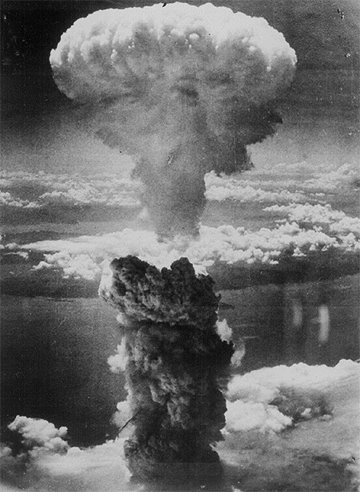
Then President Roosevelt, who so often spoke to us over the radio, died. Mama cried, and stopped singing. We dropped an Atomic Bomb on Hiroshima and another on Nagasaki. We stormed the beaches at Normandy. The war was over.

They continued to perfect the Bomb. Even after we moved from the yellow house Daddy built in Red Mountain to the house with a bird's nest in the chandellier in Inyokern, they continued to test the Bomb in Nevada. We got out of our beds early in the morning on the day of the test, stood in our front yard, and watched as the red cloud rose over the east mountains. We could see it all the way in California. And we could hear, and feel, the rumble of the shock wave several moments after.

People began to worry about the "T-Zone" in their cigarettes, Taste and Throat, and they would "Walk a Mile for a Camel." There was "Never a Rough Puff in a Lucky," and the old 'ice-box' became a thing of the past when we bought a new refrigerator. Campbell's Soup was "Mmmm-Mmmm Good!"

There were "real" faces and "friendly" faces. "Real" faces belonged to Harry Truman, and Estes Kefauver, and Clement Attlee, to Bing Crosby and Bob Hope, to Dorothy Lamour and Betty Hutton. Although some of these faces were also "friendly," I paid more attention to other faces I loved: Sniffles and Mary Jane, Marmaduke Mouse, Little Henry, the Little King, and Little Lulu, with her black ringlets, her cheery smile, her red dress, and her olive-black eyes.

Now cigarettes are politically incorrect, they'll give you cancer and bad breath, and their secondhand smoke will kill you. And Sniffles and Mary Jane, along with all those other "friendly" faces have gone the way of the dinosaur and the dodo bird.

Sunday, May 21, 2006

A Lamb's Tail


When Daddy left for work every day, he'd give Mama a peck on the lips and she'd always say, "Be careful, and don't work too hard!"

And he'd say, "I'll be back in two shakes of a lamb's tail!"

I guessed that meant quickly, as, in a flash. Hmmm.

This one is short, so you can read it quickly, in two shakes of a lamb's tail, and go on about your business.

Don't You Forget it!


"Epamanondas, you don't have the sense you were born with. But I love you just the same, and don't you forget it."

And he never did.

EPAMANONDAS, ET AL


I learned, from the age of two or three, to love books. Epamanondas was the first. Epamanondas, who carried the butter home as he had carried the cake, "wrapped up in leaves and put in his hat as he came along...." And, of course, the butter melted and ran everyplace.... Later, his Auntie told him, "I've got six pies cooling on the doorstep--you be careful how you step on those pies!" The pies sat cooling in a row on the doorstep. As soon as his Auntie left, Epamanondas went out, and he was good and careful. He stepped right--in--the--middle--of--each one! When his Auntie came back, she said "Epamanondas, you don't have the sense you were born with. But I love you just the same, and don't you forget it!" And he never did.

I can't remember a time when I was not in love with books. At Christmas, Santa Claus would often bring me a book. There was The Country Bunny and the Little Gold Shoes, a real women's lib story first published in 1939, about a lady bunny who attains the exalted position of Easter Bunny in spite of her responsibilities as the mother of 21 children. In the end, this "brave, kind, and swift" bunny must fly to a snowy mountaintop to delived a beautiful egg to a sleeping boy before she can return home to hide eggs for all 21 of her own children. The sight of the sleeping boy with that beautiful, fragile egg in the palm of his hand sent waves of dread through me. I knew the boy would wake up with no idea of the egg in his hand--and it would fall--and that would be the end of that!

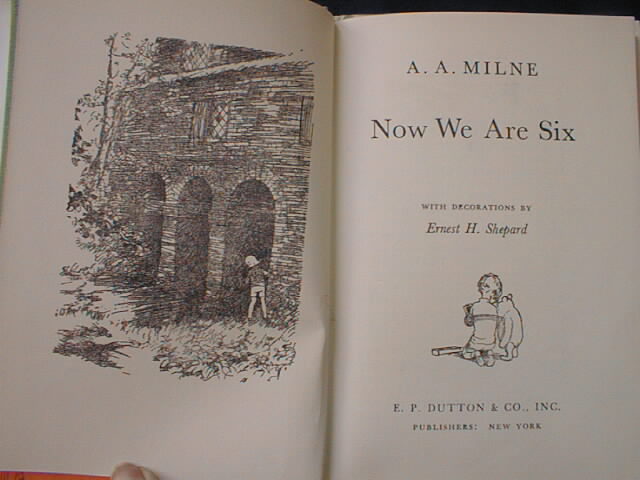
I loved the Snipp, Snapp, and Snurr books. by Maj Lindman. Babar the Elephant was another favorite. My Nanny gave me A. A. Milne'sNow We Are Six on my sixth birthday, and inscribed it: To a Nice Little Girl. I memorized it.

Then there was the comics page in the newspaper: The Teenie Weenies were tiny people who lived among the birds, chipmunks, mice, squirrels and rabbits in Teeny Weenie Town. and the Katzenjammer Kids, Invisible Scarlet O'Neil, Dick Tracy,Red Ryder and Little Beaver. The list could go on and on.

Once we got a set of encyclopedias, filled with volumes of information and pictures--a mother testing a baby's bathwater with her elbow, a story of gypies who
dyed a stolen child's skin brown with walnut juice. The set was red, with gold-leaf that said: COMPTON'S PICTURED ENCYCLOPEDIA on the front of each book. We also had a set of medical encyclopedias I loved to look at, in which various people suffered with unspeakably horrid illnesses which cracked their lips and spotted their skins. There were other pictures in which broken arms were expertly set in slings elaborately folded and tied.

In school we read of Dick and Jane, Spot, Puff, and Baby Sally. I loved the weight, and feel, and the smell of books! So, I became a bookworm. I don't remember ever learning to read. It seemed as if I always knew how, and I could never understand people who didn't love to read.

Songs My Mother Taught Me


BARNACLE BILL THE SAILOR

Who's that knocking at my door?
Cried the fair young maiden.

It's only me, Im home from the sea,
said Barnacle Bill the Sailor.
I'm all lit up like a Christmas tree,
said Barnacle Bill the Sailor.

Are you young and handsome, sir?
cried the fair young maiden.

I'm old and rough and dirty and tough,
said Barnacle Bill the Sailor.
I drink my gin and I dip my snuff,
said Barnacle Bill the Sailor.

I'll come down and let you in,
cried the fair young maiden.

Well, hurry before I bust down the door!
said Barnacle Bill the Sailor.
I'll rare and tare, and rant and roar!
said Barnacle Bill the Sailor.

I'll spin you yarns and tell you lies,
I'll drink your wine and eat your pies,
I'll kiss your cheeks and black your eyes,
said Barnacle Bill the Sailor.

If you love me, say it's I,
If you love me, say it;s I,
cried the fair young maiden.

Aye, aye! said he, It's certainly me!
said Barnacle Bill the Sailor.
Aye, aye! said he, And now we agree!
said Barnacle Bill the Sailor.

Tell me that we soon shall wed,
cried the fair young maiden.

Never again, I'll come no more!
said Barnacle Bill the Sailor.
And if you wait for me to come
You'll sit and wait and suck your thumb,
said Barnacle Bill the Sailor.

(These were lyrics from an old 1930 Betty Boop movie, but there are other, raunchy lyrics. She only sang me the clean version, although I do remember a line that went: To hell with the dance, and down with your pants, said Barnacle Bill the Sailor!)

Saturday, May 20, 2006

Self Portrait...


Who said you can't go home again! Here am I rocking on the front porch of Thomas Wolfe's home in Asheville, NC. I went back once to look for my old home in the California Mojave desert one summer, with my mother. We laughed all the way to the airport, ate peanuts and drank Cokes on the jet. The day we drove out there the desert was hot. Most of the wildflowers were gone. The town is still there, but our house was gone. Vanished. Where it should have been was a small square foundation, a lizard, a few weeds. Vanished. Like Grandpa and Nannie, and Nannie's yellow cat called "Pinky." Like my brother's black dog Sparky. Like Daddy. And Mama. Daddy was a miner. Mama said my father was always one shovelful away from the glory hole that would've made us rich.

OK. So, maybe you can't go home again. But words are magic! In 1939, Mother's Day came on a Sunday, May 14th. I was born the day after. They said Daddy leaped the fence like an Olympic hurdler to tell my Nannie and Grandpa, "It's a girl!" The newspaper headlines that day announced that Premier Mussolini gave his views on the question of war in Europe: "There are not enough problems big enough...to justify a war," he said. So, he was wrong. That day Bob Feller, pitching for the Cleveland Indians, saw his mother in the stands hit by a stray ball. Sophie Tucker, Katherine Cornell, Tallulah Bankhead, and Katherine Hepburn played on Broadway the night I was born. I was a shy kid. I told my husband I spent my childhood reading Plato and Aristotle. I lied. I wasted a lot of time under the fig tree in our back yard floating ants on boats made of leaves. I practiced flying off the swings, sure that if I wished hard enough and kept practicing, one day I would take off like a bird, and never come back.

I decided I'd be an artist. I majored in art all thru High School. Then I decided I'd be a great actress (like Katherine Hepburn), and went to the Pasadena Playhouse. I spent about a year travelling with a road repertory company, and we played seven different shows across the U.S. and Canada. I did mostly little girls and old ladies. I got tired of living in hotels and suitcases, so I left the road and enrolled at the University of Utah. My dearest friend Janet decided I was going to wind up an old maid because I hardly ever went out. I spent much of my time in the music library listening to Palestrina Masses. At any rate, I graduated in '64 with BFA in Theatre Arts and got married a couple of weeks later. And had five sons. And no money. I survived that. I survived melanoma, and wrote a book about it, called CHRYSALIS (out-of-print now, but several copies are still floating around on Amazon.com). I taught writing for several years, had a poetry textbook and a book of poetry published, IN WILLY'S HOUSE. I love to write, but have kind of gotten out of the habit. Maybe this will inspire me again.

Now that I am--almost--sixty-seven, and closing in on an ending that may be a beginning, or a continuation, I know that it's all about change. Susan Griffin, in "A Chorus of Stones," says: The body remembers who we are supposed to be. And in this there is grief.

I think sometimes I am supposed to be about four, read to, sung to, rocked to sleep in the wicker rocker on our vanished front porch, wearing my small thin body, without this unfamiliar heaviness, these strange wrinkles, this loose flesh. Last night I dreamed I was in my Grandmother's house. My mother was there. I was ecstatic. My father came past the window and looked in, and then came into the room where we were all gathered. I threw my arms around him and gave him a kiss. Then the dog woke me up wanting to go outside.

H.G. Wells said that "Man must not allow the clock and the calendar to blind him to the fact that each moment of his life is a miracle and a mystery." My life so far has been a miracle and a mystery. As all of our lives are. Isn't it grand! Almost like going home.

Thursday, May 18, 2006

Gloryhole


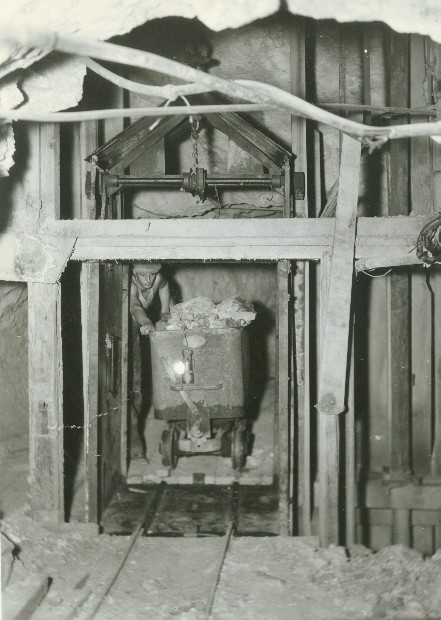
Daddy in the mine, "a penny's-worth of carbide" lit in his headlight "like a star."

Rough and Ready


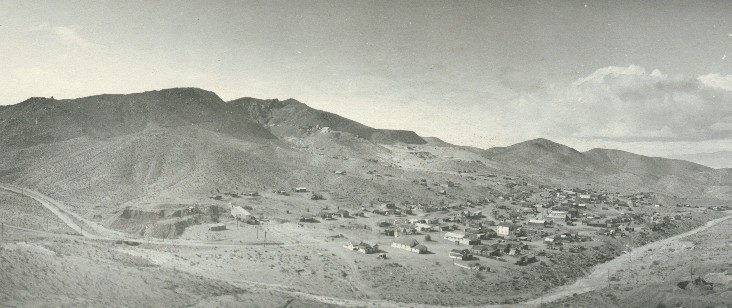
"In 1918," writes Jack McGinnis in his little book called RANDSBURG-Southern California's Greatest Gold Camp, "a big silver strike was discovered." And the Kelly mine, where Daddy worked, "was on its way to fame. It was almost unbelievable how rich it was." Other silver mines, the Silver King, Big Four, Silver Glance, Red Warrior, and the Yellow Aster were also booming. A post office was established in 1922. "The miners were calling the town Gin City, and Sin City, and the postal department soon got tired of the confusion, so they settled the name by calling the town 'Red Mountain.'

"Red Mountain was a rough and ready town. Saloons were everywhere and this was during prohibition, too. Authorities didn't seem to care and looked the other way. If a raid was planned on Red Mountain, somebody was always tipped off. Girls and liquor were plenty everywhere you went, up and down the main street. Gambling was everywhere. This was really a last frontier town in the west. There were places named the Northern, the Silver Dollar, the Owl, the Shamrock, the Palace, the Stag, and many more. The girls were all young and beautiful. Everybody had fun," he writes. My brother says, "Red Mountain was an interesting place in which to grow up. I lived there the first fifteen years of my life, and still retain many fond memories of it." He delivered newspapers to the "girls," the prostitutes down on the main street. "They were always nice to me," he remembers. He says, "My dad was the foreman at the Santa Fe mine. He had studied mining engineering through a correspondence course, and I believe he knew more than most engineers. We used to sneak to the edge of the Santa Fe and spit down it until a piece of spit hit one of the miners after gaining several hundred feet of momentum. We got chewed out plenty."

All the mines, Daddy said, were full of Tommyknockers, gremlins who caused cave-ins, who loved to trap miners, and I thought, would surely eat a child whole if one wandered too close to one of the mine shafts. I was interested in Tommyknockers, apparently more than my big brother was! On occasion I did take Daddy's lunch to him, and was lowered down the shaft in a bucket, carrying the food in my lap. The Kelly had a 1400 foot vertical shaft, a head-frame with a large wheel pulley at the top and a hoist house below where a long cable with the bucket extended down into the shaft. I never saw a Tommyknocker, but I loved going down into the mines where it was cool and damp, and smelled of rocks and carbide and old timbers that shored up the tunnel walls and ceilings. Daddy would spit in the lamp on the front of his hard hat and the carbide gave off a gas he lit with a match. The little fire barely lit the rocks walls and the tunnels were shadowey. The fires in the miners headlamps were like little stars.

Daddy came to California from Utah as a young man barely eighteen years old. His father came, too, bringing his fiddle (which, years later and restored, my oldest son would learn to play). Grandpa could make slip-bark whistles, and tie a button over a string so that, wound up, it would hum as the string was pulled tight, then loosened, and pulled tight again, an endless delight to me.

Mama taught me to play "cat's cradle" with a piece of string pulled in patterns from one set of fingers to another. Back and forth. Mama came from Colorado when she was thirteen, a green-eyed little girl with a head full of wild red hair and freckles (which she hated). She had picked cotton all the way across central California, had lived in a cave with her father, her red-haired mother, a red-haired sister named Josie, and a brother named Ray, and she had walked to school in Red Mountain along the very rim of the hill in back of our house, afraid of the wild donkeys that roamed and brayed there, leftovers from the old miner's camps before Red Mountain, Jo'burg, and Randsburg were boom towns. In time, Mama and Daddy met and married, and Mama didn't learn until they'd been married for 50 years that my father had given up what was a promising career as a professional baseball player for love. He LOVED baseball! He once pitched a no-hitter against the famous Satchel Paige, and might've pitched for the Los Angeles Angels, but for love of Mama, and mining. They didn't have much, but they had that. He built the house for her out of railroad ties. They loved each other, and they made beautiful music together, playing for dances at the White House in Randsburg, Daddy on the saxophone, slurring out sweet songs--Mexicali Rose was his favorite--while Mama played the piano. And after my brother was born he went along with them. When he got big enough, 2-years-old or so, he sat up on stage with the band on an upturned Folger's Coffee can, chewed on a make-believe cigar, and drummed alongside the cigar-smoking drummer. (Years later my second son would learn to play his grandfather's sax, and sometimes used it in his own band.)


My brother was an imaginative little boy who liked to dress up as a cowboy, making corrals with sticks and catching horned toads to use as his "horses," or as the "Masked Marvel." He was almost eleven when I was born, and was often recruited to hang out long lines of diapers when Mama needed help. He was a good boy, and a good brother. He went away to High School in Barstow when I was only three or four, and so I only saw him on week-ends and summers. He learned to play the trumpet and took piano lessons and loved model airplanes. He glued together balsa-wood frames, covered them with silk and hung them in the kitchen, and flew them across the desert, airplanes with one set of wings, or with two sets, and propellers, airplanes that smelled of balsa and model glue. And those with real gasoline engines were like birds, alive in his hands.

Monday, May 15, 2006

Rewind!


Today is my sixty-seventh birthday! Go backward sixty-three years to the day of my 4th birthday party. Find my cousin Jerry to my right, and my friends Vivian and Billy to my left. My friend Diane cried, and so is not in the picture. I was very concerned. (Inside, I am still four-years-old. Still concerned. Where are you now, Diane?)

Now I know that it's ALL about change. Susan Griffin, in A Chorus of Stones said "The body remembers who we are supposed to be. And in this there is grief." I think sometimes I am supposed to be about four, read to, sung to, rocked to sleep in the wicker rocker on the front porch to the crossing of searchlights, wearing my small, thin body, without this unfamiliar heaviness, these strange wrinkles, this loose flesh.
.

There Was A Little Girl...


There was a little girl
Who had a little curl
Right in the middle of her forehead
And when she was good
She was very very good
And when she was bad she was...horrid!

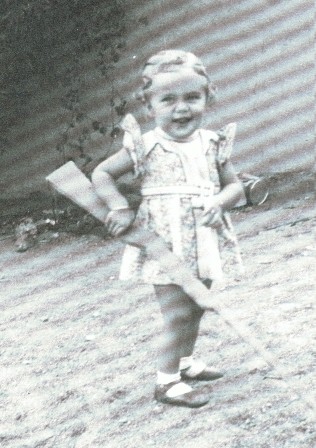
(About three years old. I remember I loved that little ring.)

Sunday, May 14, 2006

Pictures 1


Me, my first photo. Mama and me. Grandpa and me. I really loved him. I loved to sit on his lap and watch him roll his own cigarettes, from tobacco in a little white bag with a golden drawstring. He was Sheriff, and he was also a miner. He finally died of black-lung and is buried in San Bernardino, CA.

Red Mountain


In May of 1939, a man could buy a Plymouth Roadking for $645, or a tin of Bond Street Tobacco for 15c. The World's Fair was in full swing in New York City. Mrs. Roosevelt had greeted more than 20,000 Brooklyn women the morning I was born. The New York Times reported that two pickpockets and an umbrella mender "in possession of a screwdriver, pliers, and a flashlight" had been arrested the night before and were repenting in jail. James Joyce's first new work in 17 years, Finnegan's Wake was heralded in the Wall Street Journal as "The most unusual literary event of our time."

So it was. On the night of my birth, the sun, on the other side of the world, was in Taurus. The moon, on my side, was in Aries. Our house was on the side of the hill. In spring, the hillside was covered with flowering creosote, yellow asters, and pink-eyes, which, it seems to me, was another name for Indian Paintbrushes. Clumps of pink and white wild primroses bloomed everywhere (the pollen was thick and golden, and brushed under your chin would tell whether or not you liked butter, or boys, I can't remember which). Thick, waxy desert lilies decorated the roadsides. The smell of spring on the desert was incredible. By mid-May, most of the flowers had been ravaged by the herds of sheep that came through like locusts and ate everything green right down to the dirt.

Our house was yellow. Daddy built it himself from railroad ties, and a locust tree grew in the side yard. There was a screened front porch that let the cool evening breezes blow through, and an outhouse, which I rarely used, being lucky enough to have my own potty-chair beside the ice-box in the kitchen. The wars flourished in Europe, but our front porch was a safe place to be. By 1943, the Wehrmacht was in retreat, Lucky Strike Green had gone to war, and people were singing "Praise the Lord, and Pass the Ammunition." Rocking on our front porch in the evening then, Mama sang to me. She sang, Pony Boy, Pony Boy, won't you be my Pony Boy? Don't say no, here we go, off across the plains. Marry me, carry me right away with you.... There were occasional blackouts; more often searchlights criss-crossed in the dark while she sang of the Fox in the Log: Naaa, naaa, naaa said the little fox, naaa, naaa, you can't catch me!... Or Brahm's Lullaby.
Often she sang about the Poor Babes in the Woods, two children who went for a walk one day, got lost, died, and the robins so red brought strawberry leaves and over them spread.... It was the saddest thing in the world, and I cried and cried for those lost children.

A corral to the north of the house was home for old April, the brown Jersey cow who once kicked Grandpa in the head. Mama always said April was stubborn and mean and stingy, but I liked sitting on her back, my skinny legs splayed straight out, while Daddy milked her. Later, Mama heated the milk in a great silver pan to bring the cream to the top, a thin, wrinkled, pale layer she skimmed off the top with a spoon, while she complained that the cow owned by my Uncle Frank and Aunt Lauree gave milk with yellow cream that rolled off the top like a thick jellyroll.

Old April was uncooperative in more ways that this. When my twelve-year old brother helped Daddy bring her into the corral on the evening she first became a member of the family, she bolted as if she were being led to slaughter, and took off up the hillside, scattering primroses and pollen to the wind, with Brother and Daddy close behind her. They hollared and waved their arms and tried to head her off, each trying to outguess the direction she'd take next. For a cow, she'd have made a good race horse, galloping first to the north, then up the west hill, skirting bushes and galloping across gullies before heading toward town. Dad hollared for Mama to get the car, and as the sun dropped behind the hill, and it was beginning to get dark, to keep the cow in the headlights. Mama grabbed me up, and she cranked up the old green Model A, and off we went, without a word, without a road, up and down the mountain, through ditches, the Model A's headlights shooting out two thin beams of light to illuminate the first truly exciting adventure of my life!

About Me

My photo
1. In dreams I am often young and thin with long blond hair. 2. In real life I am no longer young, or thin, or blonde. 3. My back hurts. 4. I hate to sleep alone. (Fortunately I don't have to!) 5. My great grandfather had 2 wives at once. 6. I wish I had more self-discipline. (I was once fired from a teaching position in a private school because they said I was "too unstructured and undisciplined." --Who, me??? Naaaahhh....) 7. I do not blame my parents for this. Once, at a parent-teacher conference, the teacher told me my little boy was "spacey." We ALL are, I told her. The whole fan damily is spacey. She thought I was kidding. I wasn't. 8. I used to travel with a theater reperatory company. My parents weren't happy about this. 9. My mother was afraid that I would run off and paint flowers on my cheeks and live in a commune, and grow vegetables. I once smoked pot. ONE TIME. 10. I don't drink or smoke. (Or swear, much. Well, I drink milk, and water, and orange juice, and stuff. Cocoa. I love Pepsi.) 11. Most of my friends are invisible. 12. I am a poet and a writer. All of my writing on these pages is copyrighted. Borrowing (without acknowledgment) is a sin.