"Since flesh can't stay, we keep the breath aloft. Since flesh can't stay, we pass the words along." --Erica Jong

Thursday, May 24, 2007

The Summer of Love


So. Suddenly I found myself with a husband, and I became a wife. In a small apartment on Mallul, in Anaheim, a few blocks from Disneyland. From our bedroom window every night we could view fireworks over the Matterhorn and watch Tinkerbell fly from the top peak down through the exploding darkness toward the Sleeping Beauty's Castle. And a block away, out the same window, there was a big red T rising above the ThriftiMart. Life was beautiful. I listened to folk music and wrote poetry all day. I practiced playing Marv's guitar and sang along with Joan Baez and Judy Collins and wondered with Pete Seeger Where Have All the Flowers Gone?Joan said the answer was Blowin' In the Wind. If we waited long enough, the Lord would Kumbaya. The Beatles sang that Eleanor Rigby picks up the rice in the church where a wedding has been, lives in a dream....

It was the Summer of Love, Lyndon Johnson won the Presidency and 50,000 young soldiers would die in a far-off place called Viet Nam, which was of little concern at the time. Nobody had even heard of Viet Nam, really. We had no idea that once in, there would be no way out. Flowers were in Power.

We bought furniture--a blue couch, two end tables, a lamp, a brown plaster statue of Confucious, and somewhere along the line, another of comedian W.C. Fields. We bought dishes. Marv had one plate, one drinking glass, a knife, fork and spoon.... We bought pots and pans. Potholders (Marv's kids at Juvenile Hall made us an endless supply of yarn potholders). Bath towels.

We still went to Newport Beach often, got browner, ate bananas-on-a-stick, gathered collections of seashells. We went to old art films, Black Orpheus, The Umbrellas of Cherbourg. We saw Peter Sellers in Dr. Strangelove: How to Stop Worrying and Love the Bomb,
and Peter O'Toole and Richard Burton in Becket,and Anthony Quinn in Zorba the Greek.

Rent was $40 a month, and we were happy with very little money. A lonely kid from the apartment below us came up every day to visit me. Colyer Dupont was a child actor, eleven or twelve years old, with long blond hair. My hair was long, and blond. He thought I was pretty, said I was like his sister. His mother was divorced, and carless, so when Colyer went to auditions at Disney Studios in Hollywood, I took them there in my little old DKW, which ran on a mixture of half-and half, half gas, half oil--(Janet had taught me how to drive that car in the Rose Bowl parking lot in Pasadena the year before). Colyer's mother and I waited, our fingers crossed for him. All of us were living on a shoestring, you know. It didn't matter.

Marvin worked as a counselor at Albert Sitton Hall (and Orange County Juvenile Hall), a place for delinquents and homeless children. I still saw myself as an aspiring actress, an eccentric bohemian, while I tried to learn to cook and clean and be a good wife. Marv and I were very much on the same wavelength--one or the other of us finishing each others sentences, or transferring identical thoughts. Often, even our dreams at night would slide from one head to the other, sharing words and images, a unique intimacy, a sort of "meeting of spirits," like Leonard Cohen wrote about in Suzanne. In the music we listened to the singers were like friends. It was a time of great happiness.

Suzanne takes you down to her place near the river
You can hear the boats go by
You can spend the night beside her
And you know that she's half-crazy
But that's why you want to be there
And she feeds you tea and oranges
That come all the way from China
And just when you mean to tell her
That you have no love to give her
Then she gets you on her wavelength
And she lets the river answer
That you've always been her lover
And you want to travel with her
And you want to travel blind
And you know that she will trust you
For you've touched her perfect body with your mind

And Jesus was a sailor
When he walked upon the water
And he spent a long time watching
From his lonely wooden tower
And when he knew for certain
Only drowning men could see him
He said "All men will be sailors then
Until the sea shall free them"
But he himself was broken
Long before the sky would open
Forsaken, almost human
He sank beneath your wisdom like a stone
And you want to travel with him
And you want to travel blind
For he's touched your perfect body with his mind

Now Suzanne takes your hand
And she leads you to the river
She is wearing rags and feathers
From Salvation Army counters
And the sun pours down like honey
On our lady of the harbor
And she shows you where to look
Among the garbage and the flowers
There are heroes in the seaweed
There are children in the morning
They are leaning out for love
And they will lean that way forever
While Suzanne holds the mirror
And you want to travel with her
And you want to travel blind
And you know that you can trust her
For she's touched your perfect body with her mind

.

Tuesday, March 27, 2007

I Do! I Do!


WEDDING DAY--June 19th, 1964

They played Bach's Brandenburg Concertos when Marv and I were married. My brother played a French horn solo called Romance, and a friend sang Tonight, Tonight and There's A Place For Us from WEST SIDE STORY. (This friend, who was an actor, was killed a few years later during a performance of Oliver, the villan Fagan, shot by a badly packed blank bullet. )

When Marv proposed marriage, back on Valentine's Day, 1964, he gave me a heart-shaped box of candy. Inside, in the center, one of the candies was missing, and in its paper wrapper was a diamond ring. On the previous Sunday night, February 8th, the Beatles had appeared on The Ed Sullivan Show. Marianne thought they "looked like apes." Gaylen was impressed with their "backbeat." They sang I Wanna Hold Your Hand, and She Loves You, and Please Please Me to an audience of screaming teenagers. And I said, "Yes." Absolutely. Yes.

This was my third visit to the L.A. Temple. The first time was when I attended its dedication, as a teenager; the second was on September 10th, 1957, when Gaylen and I were sealed to Mama and Daddy after their marriage for Time and Eternity. Marv's best friend (and Best Man) Richard Barbieri and his wife Eileen were there for us, and Gaylen and Marianne. Janet was mad that she wasn't allowed inside the Temple for the ceremony, but she and beautiful Cindy Moller (who took time off from her job as a topless dancer at the Dunes in Las Vegas) made up for it by providing a huge bottle of champagne (which we kept in the closet, unopened, for years and years....), painting "Just Married" signs in lipstick, and tying tin cans to the back bumper of the car.

Janet was my Matron of Honor, my sister-in-law, Marianne, andMarv's little sister Jean were my Bridesmaids. I wore Janet's wedding dress, that filled both the "something old" and "something borrowed" requirements. The "something new" was my veil, with a sparkly little decoration in the front. Two of my old boyfriends were there. (There. I have survived. Do you see? I am happier than I ever was! Do you see?)

"
Hey," one of them said. "You look great!"

I smiled, knowing I looked terrific. Marv and I had been to the beach often. We were both thin and sun-tanned and golden. My hair was blonde and he had hair! I'd say now, looking back from a distance of forty-plus years, that we were perfectly perfect people. Almost.

Some wedding pictures: Marv cutting our cake with a pancake turner. Why didn't we have a knife? I have forgotten. Janet and me, smiling. "You be good to her now," she warned him. No one ever said to me, "You be good to him." At least, I don't remember it if they did. Claude Gillham, a friend whose lap I used to sit on as a five-year-old while I rubbed his bald head, gave me a hug. Mama used to tell me not to rub his wonderfully smooth head, because it would hurt his feelings. FOr the life of me I could not imagine why it would ever hurt his feelings. But this night, I did not rub his head. I held two of my cousins little girls for photographs. And I may have been thin, but my corset was so tight I could not breathe, and I thought the night would never end.

Tonight, tonight. won't be just any night.
Tonight there will be no morning star.
Tonight, tonight, I'll see my love tonight,
And for us, stars will stop where they are....

But it did. And we drove from the desert back to the city, where Marv's room-mate, a cop we called Sweet William was sleeping in the bedroom. So, at three in the morning, we threw a mattress on the front room floor, and we slept.

We honeymooned in Ensenada, Mexico. We stayed at a little motel just out of town, on the beach, called Cabanas Monte Carlo, run by some people from Lebanon, who gave us a calendar with Hernan Cortez carrying off some voluptuous black-haired, half-dressed woman. We ate tacos at places who made their tortillas by hand and cooked them over big metal drums, places run by Chinese, called Fat Choi's Mexican Food. We ate Chinese at places called Pedro's, or Juan's. We ran out of money and lived for three days on corn tortillas, goat's butter, and 7-Up. At night piteros players on the street made lovely ancient music with magic flutes and drums. We took walks on the rocky beaches and watched the sun set. I wore my hair long and loose, and Marv smiled a lot. We loved each other. I'd never had so much fun in my whole life. We were poor but happy. The village idiots.

There's a place for us,
Some day a time for us.
Time together with time to spare,
Time to learn, time to care.
Someday.

There's a place for us,
A time and place for us.
Hold my hand and we're halfway there.
Hold my hand and I'll take you there
Somehow,
Someday,
Somewhere.

.

Monday, March 26, 2007

Marvin Maurice Emerson Davis, Jr


vvv
vv


Marv and I had only known one another for about eight years, so it was sort of a whirlwind romance, you might say. *Smile* This is a good time to let you know you something more about Marvin Maurice Emerson Davis, Jr (besides his impetuous nature). He was born in St. John's Township, Harrison County, Iowa, in his Grandmother Stoddar's house, the first of six children. For a while they lived in Sioux City, in a quiet neighborhood called Morningside, where he fell in love with a little girl with a red sweater and had his first banana split, and crossed the Missouri River over the singing bridge, and carried a real pocket-knife in a pouch at the top of his lumberjack boots. His father worked in the slaughterhouses down by the river's edge. His mother was from a well-to-do Chicago family. She had taken dancing lessons, and wore ribbons in her hair. When she moved to California with her family she had a real future in Hollywood. Everybody thought so. And the California air would be healthful, a cure for her mother's consumption. The Stoddar's (Marv's mother's people) were from old seafarer's, ship's captains, Master Mariners, and such. His father's ancestors can be traced back to a Black Irish lad named Roe and an Indian medicine woman named Dancing Sun, and to a President of the United States and a Signer of the Declaration of Independence.) When he was still a little boy, the family moved to Alhambra,California. On the way, at Grand Canyon, he had a nosebleed. Once there, Marv fell in love with a little girl in a yellow dress, tried a couple of times to burn down his house, blew up seagulls with carbide-laced bread, and endeared himself to his sisters by hanging their paper dolls by the neck until they were dead or chopping them into pieces with his scissors. He wasn't always that violent. He camped overnight at Tin Can beach with his friends, and stargazed. He peddled newspapers, and --out of embarrassment, or fear-- those he didn't sell he bought with his own money and threw away down the rain gutter, rather than return the unsold papers to the manager. In school, he was required to memorize "Invictus," by William Ernest Henley:

Out of the night that covers me,
Black as the Pit from pole to pole,
I thank whatever gods may be
For my unconquerable soul.

In the fell clutch of circumstance
I have not winced nor cried aloud.
Under the bludgeonings of Chance
My head is bloody, but unbowed.

Beyond this place of wrath and tears
Looms but the Horror of the shade.
And yet the menace of the years
Finds and shall find me, unafraid.

It matters not how strait the gate,
How charged with punishments the scroll,
I am the master of my fate:
I am the captain of my soul.


"Invictus" was the motto of the United States Naval Academy, class of 2001, (the year the Trade Towers in NYC went down), hurling defiance into the teeth of the storm.

He joined the Navy when he was just seventeen, and spent most of the next four years as a radioman on Guam, an island paradise he would dream about for the rest of his life. The Navy taught him to drink and smoke cigars, and saved his life. Once, he almost drowned himself swimming alone in off-limit waters, out past the coral reefs. When he found himself exhausted, he decided to give it up, and just let himself go under. When he ran out of air, he changed his mind and resurfaced. He gave up, went under, and came up again for air several times before they hauled him in, his legs raw and bleeding from the knife-edged coral. I guess I owe the Navy for that.

When he wasn't on the island, he was on the USS Chandler, where he sat alone on the deck at night and wrote poetry, sang songs to himself, and smoked cigars-- a vice he overcame, thanks to his conversion to the LDS Church. I guess I owe the Church for that.

It was while he was in the Navy that he became converted to the Church. I met him in 1957 while I was a student at the Pasadena Playhouse. He was working as a counselor at Hathaway House, a home for abandoned and emotionally disturbed and abused children. He had a great love and sensitivity for those children. Later he worked at Albert Sitton Hall in Orange County. We had a lot of fun together. When he held my hand it just seemed to fit. We spent lots of time at the beach, or at Pershing Square in LA (which used to be a fantastic place populated by schizophrenics, street preachers, drunks, dope fiends, and Salvation Army revivals). We went people-watching at Boorman's, a market in Pasadena which specialized in packaged pig-snouts and pig-tails and pig-feet, and it was purely awful, --but fun. We had unusual dates, and he fell in love with me.

We went our separate ways for a while, while I went out on the road with the theater company, and he almost married somebody else, a girl named Jane, heiress to the riches of the Tappen Stovetop Ranges fortune. He might have had millions and lived comfortably ever after, but, as it happened... it seemed like every time I went to visit my friend Janet, for some reason Marv would always show up with his skis, or on his motorcycle. Fate seemed to be throwing us together. Anyway, I finally proposed, and he accepted, and we were married, and I'm glad, because I do love him. Penniless though I was, he thought I was "a fairy princess," and loved me back.

He had a terrible temper. He had the soul of a poet. He loved opera, Lily Pons and Enrico Caruso, and folk music-- Woody Guthrie and Pete Seeger, he loved Johann Sebastian Bach, and took me to the LA County Library where, listening with one shared headphone, each of us with one speaker, he introduced me to the Brandenburg Concertos. I owe him for that.

He's been a good father to our five sons. He's a good grandfather. He loves John Wayne westerns and old war movies (if they have no blood, and star John Wayne). He likes his poetry to rhyme. His favorite movies are The Wizard of Oz and Brigadoon. He loves to watch football on television, and his favorite color is yellow. He's an insomniac. He still loves opera. And he still holds my hand.

What else?

Saul Bellow (who won a Nobel Prize for literature) said: "I blame myself for not often enough seeing the extraordinary in the ordinary. Somewhere in his journals, Dostoyevski remarks that a writer can begin anywhere, at the most commonplace things,
scratch around in it long enough, and lo! soon he will hit upon the marvelous. I tend to believe that, at least most of the time." And H.G. Wells said that "Man must not allow the clock and the calendar to blind him to the fact that each moment of his life is a miracle and a mystery." Each moment of my life has been a miracle and a mystery. The love I have for Marvin, the birth of each one of our children, our grandchildren, have surely been miracles and mysteries. Johnny Carson asked singer Helen Reddy once what she'd do if her success would all end tomorrow. And she said, "If it should all end tomorrow-- well, I've had one heck of a ride, and enjoyed every minute of it!"

Me, too. It's all marvelous! I've had one heck of a ride, and I guess I owe my Father in Heaven big time for that.


.

The University of Utah


The U of U was on the hillside across from my brother Gaylen's house on Sunnyside Avenue. The Zoo was only a little farther up the hill. I walked to the University and back home every afternoon, and the fields behind the National Guard Armory were empty except for meadow larks and sparrows. I lived in the basement of Gaylen and Marianne's little house until their new house on Orchard Drive in Bountiful was built. Mom and Daddy were building a new house on the lot just to the west, and were getting ready to move from California. Every morning after the move to Bountiful, Gaylen and I would climb into his Volkswagen and chug off to school together. He had his new PhD in Music, and was teaching several classes in music theory and composition, and French Horn. I took Music 101 from him, and felt obligated to get an "A" because I really didn't want him to think I was stupid. I loved the class, and he was an awesome teacher. I spent much of my free time between classes in the listening library of the music building listening to Palestrina Masses. My friend Janet wrote, warning me that this was a terrible place to meet men, and she worried that I would become an old maid.

I loved my Physics and Astronomy classes. I barely made it through a year of French. Paris est dans le Sud de la France. Le Seine traverse Paris. The new Pioneer Memorial Theater had just been completed, and most of my classes were there, or in Kingsbury Hall, next to the music building. I loved to sit under the trees between the two buildings, listening to the hodgepodge of sounds coming from the windows of the various practice rooms: piano scales, violins, horns, voices.... When Kingsbury became the home of the Ballet and Dance Department, I began to live my life, from dawn until dark, in the basement of the Theater building.

My theater classes were fine. The University accepted most of my Playhouse credits, so I had all upper level classes. I wrote home:

May 25, 1961

Dear Folks, Thanks for the dress and sweater. They're very nice, and fit fine. Gaylen's house is really going up fast. The basement and floor are in. Marianne is so excited-- she's been planning paint colors and decorating and such. The kitchen is all built in. Gaylen has been trimming all the trees on their lot and yours.

Do you know who the happiest motorcyclist is? The guy with the bugs all over his teeth! And have you seen the new Helen Keller doll? Wind it up, and it walks into the wall! (Not very funny?)

I have a rehearsal at 2 this afternoon. We open on Wednesday. I got my name in the paper this morning-- spelled wrong. We have been having late run thru's lasting until after one a.m. I play Dunyasha Thursday night. One performance out of four. Amy E. plays opening night and the week-end. So Byron took me aside after rehearsal & told me why I was playing just one night. He said he was sorry I wasn't playing more, but that there were "a lot of things involved," such as the fact that Amy has been here three years, and this is the first good part she's had. Mrs. McGrath (Byron's wife, Grace) was there when he was talking to me. She said she liked my Dunyasha, and that when she looks at me she thinks of 25 plays I could do! That was nice.

I met John Jory last night (Victor Jory's son). We talked for a long time. He came again tonight, and asked where in California I lived, & how come I was here, & how I liked the Playhouse, etc. He's done a lot of shows there, since he was a little boy.

Maybe I'll just enroll in the Writer's Conference this summer, and save my money for the Fall quarter. There aren't a lot of classes offered in summer. I'll just concentrate on the Conference, and maybe some of the summer shows. I'll have to get a manuscript together-- don't know what....

Wednesday

Opening night's over. The show ran 20 minutes late. Amy felt very bad about it, she was in tears. It will be me in tears tomorrow. John Jory told me he's coming tomorrow night. And Gaylen and Marianne will both be there. So there will be at lest three people in the audience. There was a full house tonight. More later.

Thursday

We had another full house-- even had to turn people away. MY night is over. Byron patted my cheek, called me "Angel," and said it was "Swell." Who knows? Since I have just one night, there's not much use for criticism. Marianne and her mother came. Gaylen has been writing a philosophy paper all day and all night. Her mother is mad at me, I think. See, we had this weird-looking bug on the wall, it could run like hell, boy. Gaylen was after him with a piece of paper and a Kleenex. Marianne was shrieking and her mother was on his tail with her shoe, stomping and shouting, "WELL MY GODFREY, GAYLEN, KILL IT!" (That's the nearest to swearing I've ever heard from her).

"My sister'll be mad at me if I do," he said. Up to now I was just an innocent bystander. "He won't kill it," said Marianne.

"WELL I'LL KILL IT!" And Mrs. J. runs at it with her shoe again. So I took Gaylen's Kleenex & picked up the bug & put him outside. My cat was running wild by this time, rolling up all the rugs, with her eyes big and her ears back flat-- Hot damn! Quite a fun little episode, huh? The cat's all lovey now tonight. Goodnight.

Saturday

Tonight is the last night of "Cherry Orchard." Grace McGrath told me I was "just wonderful." I heard a lot of good things from a lot of people. She said I was the best Dunyasha she'd ever seen. I wish I could do it again tonight, even if Byron does feel obligated to Amy because she's been around for so long....

After last night's show my ride decided to go with the rest to a little bar called the Blue Angel. I felt awkward and out of place because everyone was getting drunk but me. Joyce the Stick. Gaylen and Marianne will begin to wonder-- I'm always bringing half-crocked people in to use the bathroom at one or two a.m.... Byron and Grace are having a cast party after the show tonight. Full house again, with people standing, crammed in every aisle. I wish you could see it.

Gaylen's going to plant a couple of little apple trees on your lot. I told him I thought Mrs. J. was mad at me. He said, "Well, she makes ME mad, quoting the Bible about the Lord sending things to torment man! The world is full of bugs-- every drop of water is full of little bugs, and most of them are harmless, if she only knew it!"
He's a good brother. XOXO

So that's how things went, generally. I went to the Writer's Conference that summer. Robie McCauley talked with me about my manuscript of stories (for 20 minutes and 6 dollars). He said my stories were too short and unfinished, and too grotesque.

Well. I got to do "Look Homeward, Angel" on the mainstage. Actually, I went to read for the understudy for Mercedes McCambridge, the actress coming from Hollywood to play Mrs. Gant. I only went along because my friend was trying out for one of the roles, and I read just because I was there, not because I expected to get the role. I was already involved in another show. Allen Somebody was doing "The Rainmaker," and I was doing Lizzy. We had several performances in Salt Lake and were taking the show to Moab in a few weeks. I could have had the understudy role. The director, Robert Hyde Wilson (we called him "Rawhide") said I read it perfectly, and he seemed disappointed and angry when I apologized and told him I couldn't do it....but he gave me a smaller part. In theater lingo, "Break A Leg" is a good-luck wish. As it happened, Ms. McCambridge actually broke her leg and was unable to come, so they hired an actress from New York, Leora Dana. She inspired me. She was a wonderful actress, absolutely awesome. Every night. I wrote home: I would love to keep trying for professional theater. If I am too old (by the time I finally get out of school) to play charming young things, then I'll play character and mother roles. After seeing Miss Dana in "Look Homeward Angel." She has played mother roles her whole career. I'm not a very charming young thing anyway!

Well. We took "Rainmaker" to Moab. And it was fun! I was Lizzie! Gene Pack, who hosted a classical music show on KUER for many years after, played my brother Noah. Steve Somebody-- I've forgotten his last name-- (he was a dead ringer for James Dean) played Starbuck. We took publicity photos in an old barn. Steve What's-his-name, standing up in the hayloft emptied the flashbulbs out of his camera down onto the bald head of Gene Pack, standing unaware below him. The flashbulbs bounced off like ping pong balls. I laughed and rolled around in the hay until I thought I would die of laughter. No one else seemed to think it was THAT funny.... Steve and I had a love scene in the "tack room." I discovered that I really liked kissing! I mean, it was 1963, I was almost 24 years old. I had certainly kissed, and been kissed before. But here, in the middle of "Rainmaker," I discovered that I really really liked kissing! And I can't even remember his last name!

Kim Hunter, who I had admired greatly since I was a teen-ager for her role as Stella in "Streetcar Named Desire," (she won an Academy Award for that), came to the U. to do G.B. Shaw's "Major Barbara." I wrote home: "I saw "Major Barbara" between rehearsals Saturday. It's a great show. I am very impressed with Kim Hunter. I sneaked into a symposium here this afternoon sort of by accident. The Theater Guild was listening to a discussion of Shaw, and "Major Barbara," and Kim Hunter was on the panel. I sat in the back with the newspapermen. (This was an accident, too, as I just walked in and sat down, uninvited. I didn't know then what, or who, was happening). Anyway, it was the most interesting hour of the day.

Anyway. I took a directing class from "Rawhide." I decided to do Christopher Fry's "A Sleep of Prisoners," which we had done when I was on the road. I cast a very good friend, Victor Gordon, a fine actor who was also Black, as God. In the 60's, people were marching for equality, and bombing churches, and killing civil right's workers and burying their young bodies in landfills. Our performance would be in a church in Bountiful, in my Ward on Orchard Drive. There were a few raised eyebrows at our rehearsals, but the show went very well. Rawhide gave me an "A". Years later, Time Magazine wrote a piece on the status of Blacks in Utah, and they interviewed Victor Gordon, who apparently felt like a 2nd class citizen among Mormons. I've always regretted that I never wrote a letter to the editor of Time, wondering if Victor remembered the time when he played God in a Mormon church?

Graduation was a blur. Forty-plus years later, I discover that the Baccalaureate Address was given by Neal A. Maxwell, "...but speaking the truth in love..." He said: "It is they to whom we look for concern with justice, whether this concern is held in spite of the fact that we live on a planet that someday will blink, quiver, and die or whether the concern is held because life on this planet is part of a continuum in which we strive for proximate justice; it is they to whom we look for some shared realism about the nature of man and for assurance and reassurance that man is sufficiently rational and good that, therefore, we need not despair. It is they to whom we look for shared concern about freedom....It is they to whom we look to place a premium upon knowledge as essential to survival in a changing world.... If all of us cannot link arms for the task of dealing with conflict by communicating the truth...we shall be a crippled culture-- a pathetic huddle of the timid, the apathetic, and the fearful-- a society likely to end as Eliot said, 'not with a bang, but a whimper.'"

*

Friday, January 05, 2007

ACT THREE: On the Road


I went "on the road" with the Bishop's Company, American Repertory Players, in the summer of 1960. A fellow I knew from the Playhouse, Mark Rawson, was one of their 22 actors. I was number 23. Mark was from Glen Falls, NY, and had done three seasons of summer stock there before coming to Pasadena. He was a member of the Oregon Shakespearian Festival. He Left the Company almost as soon as I arrived, to do summer theater in Cripple Creek, Colorado. My first show was in Denver. I'd had two days to prepare. The pay was ten dollars a week, and the Company provided our meals and a roof over our head.

My mother thought it was a big mistake. She thought it was a bad idea for me to go "bumming around the country" with a bunch of actors, and tried to talk me out of it. As it turned out, she was wrong.

I was excited. The Bishop's Company was a group of professional actors dedicated to performing plays they thought were socially significant, in churches, at universities, sometimes in prisons. It began as the dream of a young and ambitious woman named Phyllis Benbow Beardsley, who I never met, but her young son wrote a poem about her I've never forgotten: There is no other mother, either far or near, who needs so much her girdle, and uses so much her brassiere. She was a tall red-head who "took courage in both hands and made the dream a reality." I believe Christopher Fry's The Boy with a Cart was their first play, a gentle, lyric poem of a shepherd boy who packs his old, nagging mother into a cart he has made, making himself a harness of willow shoots to pull it. They set out across the hills of SOuthern England. The boy believes that when the shoots break it will be the place where he will realize God's purpose. They performed this around Los Angeles, along with another called Thor, with Angels, and Herman Melville's Billy Budd for a while before their cross-country tours began. Variety wrote: "The theatre has gone back to the church after a lapse of about 400 years. And it has gone back with all the embellishments that modern theatrical techniques and modern ways of playwriting can muster." And again, "The prodigal son has returned to the bosom of the family and may well turn out to be one of the fair-haired boys. In other words, the theatre, after wandering into some devious pathways during the past 400 years [has] returned. The return of the 'bad boy' of the arts to its cradle is not only a healthy sign, but an indication that the deliquent has grown up...." All that was said way back in 1947. In July of 1954, the Los Angeles TImes ran an article that said: "Bishop's Company Booked at Churches Coast to Coast.
Los Angeles' own drama-in-the-church troupe of professional actors, The Bishop's Company, has shoved off on its first nationwide tour...." Anyway, by the time I joined them, they had four units, two that remained in the Los Angeles area and two that criss-crossed the United States and Canada. THey had BIG plans. We will have a ship! The ports of the world will be its harbor! I don't know if they ever reached that goal, but after I left, they toured Hawaii.

Alan Paton gave his permission for the Company to adapt his novel Cry, the Beloved Country as a play. Also in the repertoire were C.S. Lewis's The Great Divorce, Rumer Godden's An Episode of Sparrows, Steven Vincent Benet's The Devil and Daniel Webster, and another of Christopher Fry's poetic plays, Sleep of Prisoners. And after all those years, we still did Boy With A Cart. The 'home' units did A.A Milne's Winnie-The-Pooh, as well as The Diary of Anne Frank.

I loved travelling. I loved the other actors. At first, as new people came into the group they were simply called "Newgirl," or Newboy." Whenever someone left, or went to join another unit, and new people came, we were given our name, and the newcomers became "Newgirl" or "Newboy."

I genuinely loved theater, and was grateful to be given this opportunity to work at something I had been preparing myself to do. While I was on the road, my best friend Janet was knocking on doors in Hollywood. I knew even then that my chances of working in Hollywood, or on Broadway in New York were remote at best--something akin to being abducted by space aliens. And with the Company, I did make it to New York, and I was a working actor!

In fact, one chilly Thanksgiving in New York City, when I was buying chestnuts from a street vendor (the wonderful perfume of roasting chestnuts is the BEST!), he went for coffee, asking me to "take over the cart," for a few minutes-- so, I also sold chestnuts on the sidewalk in New York City for a few minutes....

I wrote disgustingly long letters home, describing every cornfield and bird and Burma Shave sign we passed. Some others slept, some read, some studied lines. I remember Jim and Judy laughing hysterically over a book of Fractured Fairy Tales: Guilty Looks Enter Tree Beers, and Ladle Rat Rotten Hut, and Center Alley Enter Ladle Gloss Slobbers.

I wrote: "Hello from one of the Dirty Dozen in their Travelling Tenement! We're going to write Sleaze, Inc. on the side of the trailer. Our trash bags are overflowing with old show programs, candy wrappers, banana skins, etc. More mosquitos. It's raining again. We're thinking of calling ourselves The Jolly Consumptives. Cough, cough...."

"...We drove to Bowman, North Dakota last night. Up at seven and drive all day and most of the night. Then we'll be in Winnipeg tomorrow. Are you following me on the map? I love this!"

"...Spent last night in a hotel in Muskegon. The water wouldn't run out of the sink, and the plug in the bathtub didn't fit. I had to plug up the drain with my heel to keep the water in. Somebody's baby cried all night and a drunk talked to himself for hours outside our door. This place smells like Muskegon sounds. Yucch."

"Did you know I'm insured by Lloyds of London?"

"CHICAGO!--we have a necklace of dandelions hanging from the rear-view mirror. Yesterday I met a little girl who was overcome by standing next to a real actress! She said, "Gee, can I touch you?" SHe said she thought I was "the prettiest one" in the show! I could really get to like this. Lots of kids and old ladies ask us for autographs."

"...I feel--something I can't find words for. Like time is so short and things go by so quickly, and that frightens me...."

"Tonight we play a huge old barn of a building. I can hardly see the back wall from the stage. They've got eight baskets of flowers up there. If they don't move them, we'll all be hidden in the foliage! We went through Minneapolis and St. Paul early this morning. Can't remember much, but neither can I remember sleeping--just being tired and uncomfortable, and having my leg or my hand or arm go numb at close intervals...."

"THere was so much I wanted to tell you, but I'm too tired. About New York City, and the fly in my jello. About midnight rehearsals in hotel rooms. About all the company jokes (mostly dirty). About being so tired you think you're going to be verrry sick. And about all the beautiful people I've met."

I did, actually, meet and shake hands with Edward Teller, the Father of the Hydrogen Bomb. I didn't really know how famous (and infamous) he was, at the time. I only knew the people who introduced us told me, "Harry Truman called him before dropping the atomic bomb on Hiroshima, and said, Ed? What d'ya think?" Ed suffered a heart attack in 1979, which he blamed on Jane Fonda, for promoting her latest movie, The China Syndrome. Everybody said he was the "real" Dr. Strangelove. He seemed like an old man when I met him, but he lived until 2003!

I loved the people in my unit. Jeanne Needham was pretty, and funny when she didn't mean to be funny. Don Crail was a preacher who ran away with the circus. Dan Barrows had been in radio and TV in Cincinatti before joining the company. Chris Elm was easy to talk to, and Jim and Judy were good buddies. Jim's mother owned Brigham Young's "wine snifter," and Judy was a great horse-woman from Kentucky. She and I once rowed a little boat out on a big lake in a storm, with thunder and lightning crashing all around us. Gasping and sweating, we took turns rowing back to the dock, and when we finally got back, she said, "Thank you very much for the ride, Miss Earheart!" Frank Herold was Judy's "significant other." I once rolled Frank a cigarette made of weeds, when he ran out of his own brand. He said it was "very mild." Everybody sort of paired off--Frank and Judy, Jeanne and Clyde Phillips, and Jim and Marilyn. Freddy Goff and I were "an item" but he always smelled and tasted like cigarettes. He was good to me, wanted me to come to his home in Pascagoula, Mississippi, and promised to take me to New Orleans, to the Mardi Gras.
Ummm. Never happened. WHen I left the road to go back to school at the University of Utah, he married Carol Sunde, a sweet Lutheran girl from St. Olaf College in Minnesota. Maybe they are still married, if she hasn't passed on from breathing too much secondhand cigarette smoke. They were all truly like family.Jim Wheaton, one of the original eight, writes in his book Masks Before the Altar, "For me, each person was still an island that needed to be free...There are means of escape." For all our closeness, emotional, physically packed into the car like sardines in a can, as a "unit," each time we stopped, in every city, we were islands entire unto ourselves. Always.

I wrote: "One of the guys gave me a bouquet of scaggy wildflowers and a real hawk feather to brighten up our otherwise drab hotel room. He found somebody's falsie as we were about to leave Chicago, and he was embarrassed to ask who it belonged to. "Nobody would admit it if it was theirs anyway," he said. It didn't belong to me!"

CHEW MAIL POUCH TOBACCO, TREAT YOURSELF TO THE BEST. If Daisies Are...Your Favorite Flower...Keep Pushing Up...Those Miles Per Hour...Burma Shave. Kokomo. 14 miles. Eat. Budweiser, King of Beers. 4:24 P.M.

I wrote to Marvin: "Hope I don't have to be nice to anybody tonight. Hope they just leave me alone. I get so tired of being nice to people, saying the same things over and over. I'll be glad to get home. We'll have taquitos on Olvera Street."

Marv replied: "Looking forward to having 'Taquitos for Two,'(a new song I just wrote). Sorry this is such a short letter, but you must remember I am a short man. Although I am an intellectual giant."


I sent him one last letter from the road: "I miss you so much I could go out and eat worms. But you know how I hate to eat alone."

I had one standing ovation for a performance as Olivia in An Episode of Sparrows. And that one will have to last the rest of my life. I needed to stop. I was tired of waking up every morning wondering Where am I?, like an amnesiac from some old 1940's film. I needed a place to put things. I needed to go home. But sometimes at night I still have dreams about finding the company again, and I take off with them again, on another tour. Again. And it's almost like I've never left.

.

Wednesday, December 20, 2006

Yes, M'am.


That would pretty much be it!

Saturday, December 16, 2006

ACT TWO: No Business Like Show Business!


I. Loved. Theater. I REALLY LOVED THEATER! I loved the idea of theater~from the masks and robes of the ancient Greeks to the early Medieval and Renaissance Mystery and Morality plays and pageants, I loved Commedia Dell'Arte and Shakespeare. I loved Antigone andMother Courage. I loved Sarah Bernhardt and Maude Adams, Helen Hayes and Ellen Terry. I loved theater for eternally examining the questions of human existense, for letting us see ourselves as we were, and are.

There were plays other than these, whose titles I've forgotten, and no pictures were taken to remember them by.

Teahouse of the August Moon featured Clark Howat as the young soldier, Lisa Liu as his Japanese sweetheart, and Jerry Oddo as Sakini, the narrator. I played one of the Japanese children. I wore latex eyelids, and dyed my hair black and went barefoot. The play ran for eight or nine weeks, and when it was over, the black hair-dye wouldn't wash out, and turned my blonde hair green.

Aria Da Capo, by Edna St. Vincent Millay: A lovely play with an anti-war sentiment. One of the lines I remember: "Columbine, your mind is like an escallop of oysters--first a layer of oysters, then a layer of crumbs...." I was Columbine. Still am.

I played the Prioress in Gregorio and Maria Martinez Sierra's The Cradle Song, a "perfect gem of a play," a "wonderfully touching piece of theater" in which an unwanted infant girl is left on the doorstep of a convent and is raised by Dominican nuns. We actually went to a convent, where the sisters taught us how to move, what to do with our hands, the melodies of their chants, the beads of the Rosary...they let us wear their clothes. This is a beautifully-written, delicate play I did twice, playing different roles: at the University of Utah a few years later I played Joanna of the Cross.

Easter Song was the West Coast Premiere. I was Sarah Brute, a sort of Medieval witch who believed that sacrificing little girls would insure good crops. My roomate Janet was in this one with me, playing Kie, the wife of Soren. (She later named her first little girl, Kie--pronounded key-a). Johnny Mercer's daughter Mandy played one of the children. Her big line was, "I hate oak bark soup!" And her famous dad came all the way from Hollywood to hear her say it! During one performance, the back set wall began to fall down, and I was so "into it" I never noticed. Janet thought it was a lot funnier than it did. I hope that was not the night Johnny Mercer was in the audience.

Idiot's Delight was set in a lavish hotel in Switzerland just before the onset of WWII. Harry Van, a two-bit American entertainer is stranded there with his travelling all-girl troup, Les Blondes. I chewed a huge wad of gum and carried a stuffed dog. One performance, one of Les Blondes zipper snapped while we were dancing our stuff, and she did all the bumps and grinds with one hand behind her back, holding her costume together. But she was a real dancer, and knew what she was doing.... The play was filmed in 1939, with Clark Gable doing Harry and Norma Shearer doing Irene (E-rain-a). It ended with the bombing of the hotel, and my friend Edmund Guerrero played Wagner's Flight of the Valkuries on the piano while the bombs exploded all around us. Off the set, he taught me how to play it, but it never sounded as good. My favorite line, said by Irene: "O-ma-ha? Vere dat? Persia?"

Oedipus Rex: I am lamenting, "Where did you get the courage to put out your eyes?" Backstage, we ripped off our chitons and changed costumes without dressing rooms. Nobody seemed to notice that we were all half-naked back there.... I changed with Paul Price, who later earned some fame as one of The Village People, and on Sesame Street.

Summer and Smoke was written by Tennessee Williams. I played Nellie. In Thornton Wilder's The Matchmaker, I played Dolly Levi. The Purification was a dark play written in poetry by John Steinbeck. Three Men on a Horse was a comedy, in which I was Mable, a sort of Gun-Moll, here with Gary Necessary (who I had a crush on). I used to see Gary's name on television credits once in a while. He worked on one of the Olympics. Paul Price is shown here with Edith somebody, who lived next door in the dorm. One night I accidently locked myself in the bathroom. I could hear her singing away next door, our windows were practically on top of each other. I yelled for help for the better part of an hour--she never heard me--so I wrote poetry on the toilet paper until midnight, when Janet finally came home. She saved the toilet paper, saying, "Someday you'll be famous, and I'll have an original!" Poor Edith. She once had to cry on stage and carried an onion wrapped in a handkerchief to help her out. Everyone kept saying, "What's that smell?"

Roses for Johnny Johnson was an allegorical anti-war play. Johnny was Everyman.

And, there's Janet, doing Italian Straw Hat. I can hear her yet, wailing "But Papa, I don't want to get married!" And beautiful Myrna Fahey, who I dressed, in Holiday for Lovers. Myrna was a graduate of the Playhouse, and was in several movies and television shows. SHe did The Fall of the House of Usher with Vincent Price, the TV series Father of the Bride and in TV's Batman, she was False-Face's assistent, Blaze, among many other roles. SHe died of cancer, at 40.

There are other plays, for which I have no pictures: Ionesco's The Bald Soprano, The Sandbox, The Cherry Orchard, Bus Stop, Of Mice and Men, Glass Menagerie, Look Homeward Angel.

I loved the amber magic of the lights, the make-up, the costumes...and the applause. And if I live to be a hundred I will never fill that void.

.

Sunday, November 26, 2006

ACT ONE: Ordinary People


"There was, too, a wonderful simplicity of desire. It was the last time that people would be thrilled to own a toaster or waffle iron."


-- Bill Bryson, The Life and Times of the Thunderbolt Kid


Bill Bryson writes: In 1951, when the averge American ate 50% more than the average European, Americans owned 80% of the world's electrical goods, produced more than 40% of its electricity, 60% of its oil, and 66% of its steel. America's 5% of the world's population had more wealth than the other 95%. In fact, 99.93% of new cars sold in 1954 were U.S. brands. By the end of the 50's, GM was a bigger entity than Belgium, and Los Angeles had more cars than did Asia -- cars for a gadget-smitten people, cars with Strato-Streak engines, Strato-Flight Hydra-Matic transmissions and Torsion-Aire suspensions. The 1958 Lincoln Continental was 19 feet long. And before television arrived (in 1950, 40% of Americans had never seen a television program; by May 1953 Boston had more televisions than bathtubs).

Consider what was new or not invented then: ballpoint pens, contact lenses, credit cards, power steering, dish-washers, garbage-disposals. In 1951, a Tennessee youth was arrested on suspicion of narcotics possession. The brown powder was a new product--instant coffee.

Unlike today, when everything edible, from milk to bad spinach and mad cows, has its moment as a menace to health, in the 50's everything was good for you. Cigarettes? Healthful. Advertisments, often featuring doctors, said smoking soothed jangled nerves and sharpened minds. (What WERE we THINKING?) X-rays were so benign that shoe stores installed them to measure foot sizes. In Las Vegas, downwind from atomic weapons tests, government technicians used Geiger counters to measure fallout. People lined up to see how radioactive they were. It was all part of the fun! What a joy it was to be indestructible.

And indestructible we were then. "People knew, without a warning lable," Bryson notes dryly, "that bleach was not a refreshing drink."

White House security precautions were so lax that on April 3, 1956, a disoriented woman from Michigan detached herself from a tour group and wandered around the White House setting little fires. When found, she was taken to the kitchen and given a cup of tea. No charges were filed. The 50's did have worries. You could get 14 years in an Indiana prison for instigating anyone under age 21 to "commit masturbation." And to get a New York fishing license, you had to swear a loyalty oath.

But yes, we were still indestructible.

In September of 1957 I met my very best friend (who remains to this day my very best friend) Janet Lane. We loved each other enourmously from the start. We shared a small upstairs room at the Playhouse Women's Dorm, with ugly orange furniture and a view of the Playhouse, three blocks away. She was 19, a year older than I was. Her hair was red, her eyes dark brown, and her cheeks had dimples. I thought she was very beautiful and very sophisticated. She thought her nose was too large. "It's
my father's nose," she used to wail. SHe smoked. Sometimes we talked all night long, whispered to each other things we had never told anyone else. She swore, and taught me to swear. (I don't swear anymore--much--but I still know how). She informed me which of our fellow students were "gay," and what being "gay" was. (I was dumbfounded and amazed. What an incredible and inconceivable revelation this was!) She gave me sisterly advice: "For Heaven's sake, fix yourself up a little bit, use some more make-up. Eye shadow. And don't wear pink! You look like Alice in Wonderland in pink."

"You glow on stage," she told me later.

The dorm, actually Hale Residence Hall, had rules. All meals must be eaten in the dining room, not in the kitchen, and on trays provided you. (Well, I always ate in my room, vegetable soup, cold spaghetti, directly from the can). The piano must be used ONLY from 7:00-8:00 p.m., the television must be turned off at 10:00 p.m., and of course, may not be played at the same time. Callers must always be out of the dorm by 10:00 p.m. (There was a ladder the girls used to climb out the windows, or to allow callers to climb in.) On SATURDAY and SUNDAY mornings, no caller is permitted in the dorm before noon...etc etc etc.

We worked hard, preparing to be famous. We rehearsed often until near midnight, and then went to "Tops" to eat French fries before going home to bed. We exchanged photo stills from whatever show were were doing. I worked with wonderful, witty, talented people: Myrna Fahey was beautiful, had done several movies, and was sweet to me. Gita Maynard thought I was lovely, and Barbara Drew signed her photo, "Joyce, you've been a darling...." Holly Harris was spectacular, Jerry Oddo, playing Sakini in Teahouse of the August Moon scrawled his autograph on a program cover, and wrote: "To my personal Alice in Wonderland. My love and kisses for being so wonderful to work with. You will find your 'cricket'." Lisa Liu was was charming and graceful as the Japanese sweetheart. From another old program cover: Holiday for Lovers. "All the best, from here on to the top!" I actually shook hands with Burt Lancaster, and Bette Davis, and Piper Laurie! Burt smiled broadly and looked right past me, Bette wore a turban, and Piper was--well, really, really beautiful. Well. We were nothing if not optimistic. Alice in Wonderland. It was an image that seemed to follow me around, and when I actually had the opportunity to be Alice at the newly-opened Disneyland, I turned it down because I was homesick, and wanted to spend the summer at home. Charlotte Stewart, who lived in the room next door grabbed it, and went from there to a regular role as the schoolteacher on the Little House on the Prarie TV series. My friend Makoto Iwamatsu, "Mako," did the best "Puck" I have ever seen in Shakespeare's Midsummer Night's Dream, and went on to be nominated for an Academy AWard "Oscar" for his performance with Steve McQueen in The Sand Pebbles. Margaret O'Brien and John Drew Barrymore did Romeo and Juliet on the Mainstage. Most of us you have never heard of.

I wanted to write. I bought a bicycle for five dollars and pedaled it down the hill to Pasadena City College, where I took writing classes from my first real "mentor," Helen Hinckley Jones, a marvelous teacher and friend, who had written histories of Israel and Iran, of Utah and the railroad, and another book about Iran, A Wall and Three Willows. She liked what I wrote, and took a special interest in me. She loved me, and I loved her. Years later, when I began to publish articles and poetry, and wrote Chrysalis, she wrote me letters of congratulations and encouragement. But that's a story for another day.

My roommie Jan was going with (and later married) David Isenhart, a young artist from San Francisco, who had studied painting with Richard Diebenkorn. His paintings were large and abstract, with thick swatches of color. He made pottery, fashioned himself a necktie out of brown yarn, cat hair, and popsicle sticks. He dripped colored wax candles over the tops of wine bottles. He read books by Lawrence Ferlinghetti,Kenneth Patchen, Jack Kerouac, and Alan Ginzberg. I read them, too. We were birds of a feather. Janet said we were the "only true beatniks" she knew. I kind of wafted from the end of the "beat" generation into the "Flower Children," and ended up becoming a "hippie" of sorts, and stayed that way. But that's another story for another day.

I ran around with sweet Bobby Giles, who was inescapably "gay," who wanted to be a writer as well as an actor, and who, bolt out of the blue, decided he was in love with me and wanted to get married. Kissing Bobby was like kissing a plastic doll. This was an unforseen event that surprise me, but we remained good friends until his death, writing letters, sending pictures and Christmas cards and such, even had a few visits in between his visits from the Philippines and Japan. The last time I saw him we lived in Provo, Utah. I was married and had three little boys, and was about eleven months pregnant with the fourth, another boy. Another story.

I went out (for a while) with some cowboy dude whose name I can't remember, who thought he was John Wayne, and who, on a hike in the mountains, left me stranded on a huge rock because he had no idea how I should get down. I figured it out. I went out (for a while) with a fellow from Cal Tech, a true egghead rocket scientist, whose apartment walls were papered with pictures of near-naked girls torn out of Playboy Magazines. I carried on a long-distance romance with a cute sailor named Chuck, who after we broke up sent me a long letter signed with a skull and crossbones. I went with an actor, a champion fencer, who drove an Aston Martin, whose mother was an opera singer and father was a biologist who researched regeneration of tissues by cutting earthworms into pieces (another story, probably best left untold). And another with a boy named Jerry Meyers, who kept an aviary of birds in his yard, who called me "Juice," made fishing lures with peacock feathers he kept in big bright green and purple bouquets. Jerry loved photography, loved martial arts, and had a black belt in Karate. He could break bricks with his fingertips. It was while I was with Jerry that I met the love of my life, the real deal.

Marv was an idealist, a dreamer with the soul of a poet. We ate Mexican at Ernie Jr.s, we had taquitos on Olvera Street, and shared one headphone at the city library, listening to Bach's Brandenburg Concertos. I think of our time together as bonfires at the beach, waterfront carnival lights reflected in the water, seen from the top basket of the ferris wheel. He was folk songs on his guitar, and collections of sea-shells. He was long walks out to the end of the pier where little boys and old men threw fishing lines out into the waves, and he was the shrill cries of seagulls. I knew what his favorite color was, and he thought I was a "fairy princess." We sat in our shallow sandstone cave and looked out at the ocean. We ate tuna fish sandwiches, and he wrote I LOVE YOU on the brown lunch bag and hid it in a hole in the rocks. Sometime, we said, we'll come back, in fifty years or so, a little wrinkled white haired lady and gentleman, holding hands, to see if it is still there. Our bodies were covered with sand and salt. We laughed and were happy and alone in
the world. I never said "I love you" to anyone else.


.

Monday, November 20, 2006

Brother


Gaylen "A" Hatton (Excerpts from A Brief Overview of My Life)

"I was born in Osdick, California, on the 4th day of October, 1928. Osdick was named after Pete Osdick, who lived until the 1940's. Pete was an old miner who always wore a sprig of greasewood in his lapel to show that he was proud of the desert. For some reason the name of the town changed to Red Mountain, because of the big red mountain to the east. Main Street in Red Mountain was about a mile long, surrounded by mines, shacks, homes, and saloons (each with a red light)...the Shamrock, the Palace, the Owl, and Roxie's, which was across the tracks by the house where the old witch lived, and there was a dump at each end of town which I frequented, looking for treasures. Mattress Jack lived lived on Main Street in the remains of an old panel truck. He came up the street one day, and my friend Dale Edwards grabbed his hat off his head and ran with it. Mattress Jack tried, but couldn't catch him.

I thought curly hair was 'tough' & had my mother curl my hair with a curling iron, and dressed in a makeshift 'Masked Marvel' costume. I could lick anybody. Aunt Josie ran the Post Office. I sneaked in one day with my new cap gun, hid below the service window and rang the bell. When Aunt Josie came, I put my hand up over the edge and pulled the trigger. She almost died from being shot with a cap gun. I thought it was a pretty good joke. I can still remember hearing real gunshots at night while in bed, and I always worried about my grandfather, who was the Constable. He was supposed to have been in a running gun battle with someone, but I was never told the details. The only time I ever saw him shoot was when he shot a dying, rabid dog I found on my way to the dump.

I used to sell papers, magazines, etc. for spending money. I would hit every saloon on the street, and the miners and the 'girls' were always generous in helping me out. I was a pyromaniac. I set my dad's shed on fire. I set a fire in the back of our garage, which was put out just in time to avoid exploding some barrels of gasoline and heating oil. I set the whole desert on fire by throwing a match into a dry sage brush. Half the town had to help us put it out. I found an old automobile headlamp that used as oil wick. I put gasoline in it and burned off my eyelashes when it exploded. I whittled off the heads of matches to make small explosives. By putting them in a piece of pipe sealed at one end I could shoot out a wad of tinfoil that would penetrate an orange. I'd put match heads in 30-30 shell casings and hit them with a hammer to make them explode...Without TV or video games we had to be creative.

I found an old beach umbrella, took it apart, tied ropes to the canvas part to make a parachute, tied it to my waist, and jumped off the highest part of our garage. After hitting the ground hard enough to break my legs, the parachute unfolded in front of me. I decided I would have to jump from a greater height, and considered jumping from the headframe of the Santa Fe mine, which was about 75 feet tall, but I could never get up the courage.

My dad was a hard rock miner, and a great baseball pitcher. My mother was an artist. I thought she was the most beautiful woman in the world. She would sing as she worked at home, and I thought her voice was beautiful. I thought she should be a movie star, since she surpassed all of them in every way. I remember the Christmas when I received a pair of leather chaps. I was about four years old. I didn't know they were to be worn over one's pants, so I tried them on without any pants, rejoining all of the family with my butt showing through the back of the chaps.

We raised chickens and I sold eggs to the neighbors. We had a mean milk cow for a while, who kicked everybody who tried to milk her. She would get out of her fence and everybody in town would have to chase her. There was never anybody who had more love and sympathy for animals than my mother. She has influenced me greatly in this respect, and to this day I find it difficult to kill anything, and rarely do I eat meat.

Dad and I worked a tungsten mine about thirty miles North of Red Mountain, on the edge of China Lake. We worked that mine, just the two of us. I loved working with my dad. It was hard work, but I was in the best shape of my life. I could carry a bucket of tungsten high-grade ore in each hand down a mountain slope for some distance, and dump the ore in a special place. Each bucket would weigh as much as 150 pounds. I wanted to study aeronautical engineering, and planned to attend Cal-Poly at San Dimas. For some reason, I changed at the last minute and decided to be a music major at Brigham Young University. I have never been sorry. I got my B.A. Degree at BYU in STring Bass Performance. Then, my M.A. Degree at BYU in Composition. Finally, my Ph.D. Degree at the University of Utah in Composition with a minor in Philosophy.

My parents bought me a drum set when I was about four years old. I used to watch Mr. Moore chew on his cigar while he played the drums for my Dad's dance band, and I wanted to be a drummer like him. My parents played lots of 'feed the kitty' dances. I could accompany fox trots and waltzes quite well at the age of four. When I was ten, my parents bought me a trumpet. I loved it.

After graduating with my B.A. Degree, I was drafted into the army, and I found myself being shipped out to Germany. I was first stationed at Dachau, where the famous Jewish concentration camp had been located. The place had a terrible odor. I saw the ovens where the bodies had been burned, and the big tree that had died after the ashes of 25,000 Jews had been buried next to it. The European Band School was at Dachau. I had a choice of joining the 7th Army Symphony or going to a band unit in Frankfort, and I chose to go to Frankfort, where I studied Horn with Joseph Stegner, and string bass with Wilhelm Kramer...excellent musicians. I was transferred to a band in Verdun. I played parades and concerts, and played bass six nights a week in a local club. The Jazz combo consisted of four of us, piano, trumpet, bass, and drums. What an excellent group it was, playing mostly Be Bop. At first I got blisters on my fingers, then blood-blisters underneath, and finally callouses.

I came back to BYU from the army--I was considering going to France to complete my studies at the Paris Conservatory, but Dr. Leon Dallin urged me to study with Leroy Robertson at the U of U, where I could play in the Utah Symphony at the same time. Robertson was a great and inspiring teacher. My thesis work for my Ph.D. was a composition for ballet called Toxcatl, based on Aztec history, during the periodic 'War of the Flowers' between the little Republic of Tlaxcala and the mighty empire of the Aztecs. It was performed by the Utah Ballet, predecessor of Ballet West in May, 1963. I was invited to audition for third horn, and was hired by the Utah Symphony. Maurice Abravanel, the conductor, became a good friend, and was responsible for commissioning some of my orchestra music, and engaging me to do many special arrangements when needed. One of these, El Noche de
Los Tropicos,
I put together from stuff found in the New York City Library...music originally composed by Louis Gottschalk. The piece was recorded by the Utah Symphony for Vangard Recording Company.

While performing in the pit for a ballet performance, one young ballerina, Marianne Johnson, caught my eye. Sunday she attended a study group with me. Monday we were engaged to be married. We were married in the Salt Lake Temple on August 6th, 1958. We have four good children, Nannette, Keven, Heidi, and David, and several grandchildren.

We moved to Sacramento where I taught at Sacramento State University and played principal horn in the Sacramento Symphony. Marianne danced important roles with the Sacramento Civic Ballet. We were there for sixteen years, and continued to go to Sun Valley every summer, and then to festivals in North Carolina and Pennsylvania. In 1979 we returned to BYU, where I played in two faculty groups, Brassworks and Orpheus Winds. Brassworks, on several occasions accompanied the Tabernacle Choir on tours around the world, and Orpheus Winds was invited by the Chinese Minister of Culture to spend some time in China, lecturing and performing at three of the conservatories there. What a great experience for all of us, making new friends, seeing the Great Wall, and the clay figures at Xian. I have been fortunate to be able to play music in seventeen foreign countries, and around the United States, and Marianne has shared many of these experiences with me. I have performed with such great groups as George SHearing (on bass), Mannheim Steamroller (on horn), and have accompanied Margaret Whiting, the Lenon Sisters, Liberace, Ray Charles, and many others. I played a jazz concert once with Paul Horn, Conte Condoli, and Milton Bernhart...I could talk almost forever about my music associations and experiences. There are other things in life that are more important, but music has surely been a wonderful thing to me.

My Dad's family all came to Red Mountain from Utah to work in the mines, aunts, uncles, cousins, and even some friends. Some had been baptised into the LDS Church, some not. In any case, there was no LDS Church in Red Mountain. Occasionally, some Mormon missionaries would come through for a few days. WHen I was fourteen, President Bunker of the California Mission came to Dad's mine one day. He called my Dad aside, reached into Dad's shirt pocket, took out his pipe, and threw it off into the sage brush. Then he called my Dad to be the Branch President of the new Red Mountain Branch. We held our meetings at our house. About a dozen people would attend the meetings. At fourteen, I was baptised. Dad ultimately became the Branch President of the church in Ridgecrest, and then the Bishop. I returned to Inyokern when discharged from the army, and before returning to BYU to get my M.A. Degree, my Mother and father went with me and my sister, Joyce, to the Los Angeles Temple, where our family sealings took place.

I have had occasion to teach various Sunday School classes, youth classes, Priesthood classes, etc. I have led choirs, been a Bishop twice, and Branch President of the Fruitland Branch--before being made Branch President I was the finance clerk, priesthood leader, organist, Primany accompanist, and choir accompanist. I know the Gospel is true...that God lives...that Jesus is the Christ...that Joseph Smith was, and is, a Prophet of God...and that we are guided by a prophet today...and that it will continue to be so. That is my testimony to all that will hear it!


Oh, Cruel Thorns

Oh, cruel thorns, were thou upon my brow,
whose awful twinings on my Lord pressed down;
Might I not wish thee gone, nor hope to know
A sweeter death beneath thy crown.

Thou pierced hands, and body wounded sore;
The heart's blood spilling down as somber rain,
My heart and hands do reassure those scarlet welling drops
Fall not in vain.

O precious signs, so pure and undefiled,
Of holy flesh and blood in sacrifice;
May I become in faith a little child,
Partaking guiltlessly before His eyes.

And weary feet, who paid thy fearful toll
Upon the stony way to Calvary;
Set now thy prints upon my soul,
And I will walk in joy, to follow Thee!

--Onita Davis
.

Thursday, November 09, 2006

A Letter from my Brother

October 13, 1957


Dear Joyce,

Thanks for the letter--I enjoyed hearing from you, and hope you are able to write often. I am happy that you like it there--it will be a wonderful experience for you, and you should get a great deal out of it. You mention that you suddenly find yourself among a lot of people more talented than yourself; this will alway be the case, so don't let it discourage you. Just as we are often most critical of those faults in others which we do not possess ourselves, it usually happens that we are likewise made very conscious of their virtues which we seem to lack. I have very good pitch discrimination; yet I have been discouraged by others who are gifted with absolute pitch. Many others memorize better than I, and while beginning to labor with languages I was very discouraged to make the acquaintance of a young man who had a fluent command of at least seven languages. I cannot memorize scriptures, and other people know the Bible backward and forward. I cannot play horn as well as many others, and I feel inadequate playing jazz on the bass. My ability to compose and arrange seems weak in comparison with others.

However, I have recently acquired a changed attitude concerning these things which used to worry me so much. I find that I usually play better in tune than one person who has absolute pitch. It is difficult for me to memorize languages and scripture--but I was engaged by the symphony on the strength of an audition during which I played all their requested horn passages from memory. I have been complemented on being the best third horn played the symphony has had. And, I am getting compositions performed and commissioned even more than my teachers, who are recognized composers. And the best bass player in town, whom I have eulogized on occasion, has told several people that he wishes he played as well as I. So, you see, I have decided that while we all envy the talents of others, they envy ours in return--we are generally more talented than we think. It is healthy for a perfectionist attitude to spur us on--when we believe that everything we do is not quite good enough, and we try constantly to do better. It is not healthy when we degrade ourselves and become discouraged and quit. Many talented people have given up their work simply because they have felt they could never equal the work of other talented people. Not all writers can win the Pulitzer Prize--but most can be happy successful writers. Not all composers can win the Guggenheim Award, but they can still create and know the joy of hearing their work. Every pianist will not be a Rubenstein, nor can every violinist be a Heifitz. Most conductors will never wqual Toscanini, and every artist cannot be a Van Gogh or a Picasso. I could go on indefinitely--but what I am trying to say is simply that there is a lot of room in the world for talent of every kind, and everyone can be a success without necessarily being the greatest in his respective field. Anyway, who is to judge?

Well, enough of my sermon! All is well here. I am not in school this quarter, but I am concentrating on German privately instead. I would like to pass the exam in January.

I had seventy-five copies of the choral composition made up, and it should be sung definitely in January. I am enclosing one of the choral parts which lacks all the brass and timpani accompaniment. It will be recorded, and I'll send you a copy.

Abravanel just called and said I have definitely been awarded the Rosenblatt Award this year. It is a $250.00 award for the commissioning of a new work to be played by the symphony. I am in good company, since those receiving the award before have included Crawford Gates and Leroy Robertson.

Well, Joyce, I hope you continue to enjoy your work there. And please continue to write whenever you are able. I'll try to answer everything I receive. --Be good!

Love, Gaylen


(I think this was good advice, and pass it along.... The choral composition he mentioned was a poem of mine which he set to music, Somewhere Lies a Line. He also used a text of mine called Jael, for a short opera he composed. And most recently (April, 2000), I was pleased when he asked me to provide and edit the text for a piece called Apotheosis, based on the writings of Neal A. Maxwell, and performed by the Ricks College Chamber Orchestra and Collegiate Singers. A CD was made for Tantara Records, as part of the Heritage Series, called Three Sacred Works.)
.

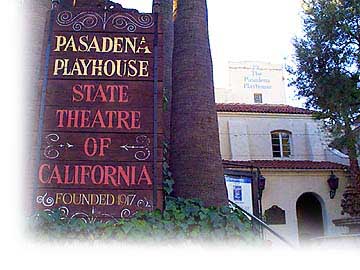
The Playhouse


SCENE: The Pasadena Playhouse College of Theater Arts.
TIME: The Present.
CAST: About 270 future Sarah Bernhardts and Laurence Oliviers and (implied in the wings) a list of distinguished graduates whose names you have seen in neon.

As the curtain rises there is a brief flashback to 1916. In a funny little theater called the Savoy, there is a small troupe of professional actors led by Gilmor Brown. They are presenting a different play every week. Then, there is a rapid series of scenes. These show Brown trying to maintain at his own expense a producing group composed of a small nucleus of professionals assisted by a larger group of amateurs, the Pasadena Community Playhouse. As these scenes fade out like calendar pages being flipped up through the years, the action returns to the present. Brown, now an alert 83, sits in his memoir-lined office at the Playhouse.

Activity in the classrooms, rehearsal rooms, the small student theaters, and the main stage down below attest to the success that he has brought to his beloved theatrical institution. In addition to its fully accredited College of Theater Arts, which was established in 1925, the Playhouse has gained a notable niche in the theatrical world with its Main Stage productions. There have been more than 2600 of them produced there, 125 of which were world premiers. And many of the best actors and actresses have trod its boards either as students who carried spears and went on to fame, or as recognized professionals who have starred at the Playhouse out of respect for its reputation, or to take advantage of it as a recognized showcase for their talents with the orchestra seats teeming with movie talent scouts.

As a school, the college offers a two-year course in three phases of theatrical arts--acting, technical and television. There is also a three-year course that leads to a master's degree. It includes what must be the most fascinating "final exam,"--choosing and editing a script, producing and directing a play.

The first-year course is the same for all students. It consists of the basic techniques of acting, speech, history of the theater, stage movement, fencing, and dancing and make-up. In the second year, students select their major, receiving intensive and specialized training in the category of their choice--stage, movies, or television, or any of the technical aspects of any of them. The third year, of course, is devoted to continued development of the student's specialty.

Within the Playhouse are three tiny, but well-equipped theaters. They frequently serve as classrooms during the day, are opened to the public at night for student productions. And, of course, there is the Main Stage, where advanced students can compete with professionals in readings for coveted parts.

Students fence on the roof garden, bound and bend in the dance halls, listen to serious lectures in classrooms, go through wierd vocal exercizes to improve their diction, pour over the thousand of tombs on the theater that line the school's extensive library shelves, and, like students everywhere, chatter in the corridors between classes and gab in the snack bar.

That the Playhouse does a competent job of training is glaringly apparent from its list of illustrious graduates. It's impossible to name them all, but here are a few names you might recognize: Dana Andrews, John Carradine, John Conti, Victor Jory, Wayne Morris, Preston Foster, Robert Young, Lee J Cobb, Lloyd Noal, Onslow Stevens, and many others." To which I might add the names of Makoto Iwamatsu (Mako), who was once nominated for an Oscar for his role in "The Sand Pebbles," with Steve McQueen, and Dustin Hoffman, and Charlotte Stewart, who played the schoolteacher on the "Little House on the Prarie" TV series, who took on the role at the newly-opened Disneyland of "Alice in Wonderland" which I might have had but for homesickness.

(This article was written years and years ago for the Los Angeles Times newspaper, by Art Ryon. We went back to Pasadena and visited the Playhouse in 2000, the turn of the century, and found that nothing lasts forever. The theater is still going strong, but there is no longer a school. The student theaters are storage areas, the Playbox, downstairs, is a coffeeshop. But the great curtain with a picture of a ship, on Mainstage, remains.)

About Me

My photo
1. In dreams I am often young and thin with long blond hair. 2. In real life I am no longer young, or thin, or blonde. 3. My back hurts. 4. I hate to sleep alone. (Fortunately I don't have to!) 5. My great grandfather had 2 wives at once. 6. I wish I had more self-discipline. (I was once fired from a teaching position in a private school because they said I was "too unstructured and undisciplined." --Who, me??? Naaaahhh....) 7. I do not blame my parents for this. Once, at a parent-teacher conference, the teacher told me my little boy was "spacey." We ALL are, I told her. The whole fan damily is spacey. She thought I was kidding. I wasn't. 8. I used to travel with a theater reperatory company. My parents weren't happy about this. 9. My mother was afraid that I would run off and paint flowers on my cheeks and live in a commune, and grow vegetables. I once smoked pot. ONE TIME. 10. I don't drink or smoke. (Or swear, much. Well, I drink milk, and water, and orange juice, and stuff. Cocoa. I love Pepsi.) 11. Most of my friends are invisible. 12. I am a poet and a writer. All of my writing on these pages is copyrighted. Borrowing (without acknowledgment) is a sin.