"Since flesh can't stay, we keep the breath aloft. Since flesh can't stay, we pass the words along." --Erica Jong

Tuesday, October 03, 2006

Poor Donald Duck


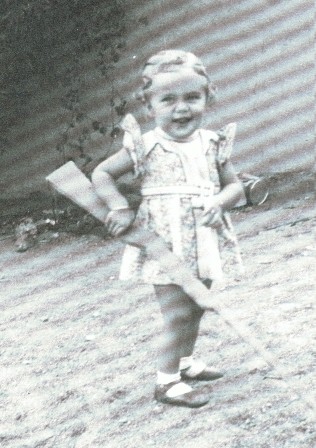
At ten. Embarrassed by my crooked teeth, afraid to smile. But not yet old enough for this to be a great hinderance to my self-image. I still like to play with dolls, and paper dolls, and read books, although my best girlfriends are beginning to like boys. My animals have become my best friends, my dogs and cats and birds. I am traumatized when some adult decides to shoot and kill all the cats and kittens that live in the bamboo field. My friend Carlita's dad decides to murder her pet duck, Donald, right before our eyes, the bastard. And I have to get braces on my teeth (which I will wear for the next three years). My big brother is away at college most of the time, and I spend a lot of time alone, drawing, trying to read Shakespeare--some sonnets, The Rape of Lucrecia, Hamlet. I have to look up the word rape in the dictionary, and I am intrigued by the concept. The picture of fair, mad Ophelia floating down the river, trailing daisies and singing mad songs stays with me yet. And my own grandmother, my dad's mother, whose name was Josie, and whose photograph at the age of twelve--about my age--was hung on a bedroom wall and used to whisper sibilant riddles to me, her paper lips moving mysteriously, scaring me. My best friend, my dog Lucky, was run over by a car while I was at school, and my dad buried him somewhere out on the desert. I searched tirelessly for his grave (as I had for my brother's dog, Sparky).

The family was still all together. Bacopickle and John lived next door. Uncle Ray and Aunt Louise, my mother's brother and his wife, and their three children lived close by. My cousin Wanda, who we called 'Ginger,' made me costumes out of old bedsheets and curtains. We practiced backbends and frontovers and cartwheels every evening in the front yard. We played hide n' seek until it was too dark to see. We ran until we were salty with sweat. My brother Gaylen, the year before he went away to school at BYU, and our cousin Billy, made gasoline engine model airplanes and flew them in circles out on the desert. My brother had an absolute passion for airplanes, and flying. He wanted to be an aeronautical engineer. Model airplanes were suspended on wires and strings from ceilings all over our house. Billy's nose always told him when Mama or Bacopickle were baking bread, and he was always the first one in line for the first hot-out-of-the-oven slice with butter. (Billy survived Korea, and was killed in a car wreck outside Las Vegas a few months after his discharge. Gaylen went on to the university and majored in music, becoming a composer and a professional musician--but he still loved flying.) Dad's sister Lauree and her family lived nearby and we ate Sunday dinners together after church, either at their house or at ours. Mama's sister (also Josie) and her two beautiful daughters, Donna, and Deana Rae, were just a house away. I loved them all immensely. Still do. The Family.

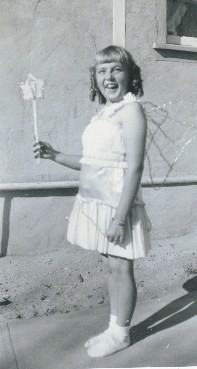
I still danced with Miss Dee. I had my first role in a Christmas play at school, as the 'Christmas Fairy,' with tinsel sparkling on my fairy wings and costume (made from an old silk petticoat of my mother's -- another great embarrasment to me. I cried, and complained, and carried on over that one for days!) and a sparkling magic wand. I don't remember much about the play, but my role was to help Santa by bringing in animals. My lines were: "Come birds, come! I need you!" and "Come bees, come! I need you!" Well, it wasn't Shakespeare. But, who knew? And actually, it wasn't really the first. The Christmas before, I had a line as one of the Crachit children when we did Dickens A Christmas Carol. "I hear the pudding singing in the basin!" That was it. Our onstage Christmas feast was Spam, hidden behind a paper mache turkey, and red Jell-o.

.

The Stuff Dreams Are Made Of


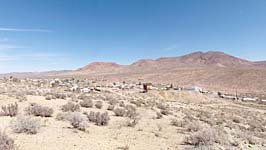
There is a curve in the road from Randsburg going into Red Mountain, where a drunken and bloody wild woman with frenzied hair once ran down the hill to the road and flagged down our car. Without invitation, she wrenched open the back door and climbed into the back seat beside me, smelling of whisky, blood dripping from her elbows, and screaming crazily, "He's going to kill me! He's going to kill me!" Alarmed, I almost climbed out the other side. Daddy drove her down to the saloon, where she wanted to get out. --

But that's not my story. My story is the dream I still have repeatedly of going back to Red Mountain, around the curve in the road, trying to find my Nanny's house, my Aunt Mame's house, Bacopickle and John's house, and our house, just below the two rusty water tanks on the hill. It seems I know just where they should be. But they are not there. And Mr. Apple's store, where Vivian Rollins and I used to go for Eskimo Pies and Delaware Punch. She'd say, "Charge it," and they were magically ours, without our having to pay any money. Apple's store is still there, empty but for an old piano, rusty bedsprings, some old Coca Cola posters, and lots of dust. But the rest is all the stuff of dreams.

Monday, October 02, 2006

THE NIGHT THE ARCADE BURNED


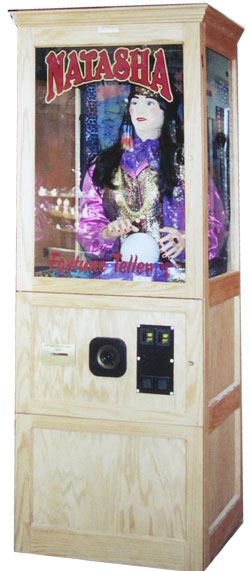
The night the Arcade burned the air turned red
as blood, a midnight mummy-shroud of smoke
wound up the sky, an ash and cherry cloak
that so lit up the glass, the house, the shed
containing all the Gypsy's magic strings
that moved her wooden hands, her ruby rings.
Oh, fire! Fire! forever in my head!
She should have known, that lady in the box,
and played a lucky card to break the locks.
She should have felt the lick of doom, have known
the itch of ghostly flame that was her own
undoing. I watched for a penny card,
some remnant of the cindered holocaust
that showed the Gypsy's fingerprint, unmarred
and pointing where the Exit sign was lost.


One night, after dinner was over and the dishes had been washed and dried, while the grown-ups were in the kitchen playing Poker at the table, I went to the front room and entertained myself with the piano bench. I turned it over and climbed into the little box the upside down seat made. I had a tea-strainer and a few red, white, and blue poker chips they gave me to play with. When I shook the round white chips in the tea-strainer they made a sound like eggs boiling in a pan. So, the piano bench turned upside down became my "boat" and I began "cooking eggs" for my picnic. I had hardly begun when I happened to glance up at the window in the front door. It was RED. I climbed out of my boat and went to look out the door. To my horror, the PENNY ARCADE across the street, where my friend Nancy and I often spent our afternoons buying trading cards with pictures of bubble dancers and movie stars, where we sometimes had our fortunes told by the gypsy lady in a glass box, where my brother once won a metal army tank by guiding a mechanical claw toward his prize, was ON FIRE! I ran to tell the adults, "It's burning! The Arcade is burning!" And nobody listened. No one paid attention to my excited rantings. So the Arcade went up in flames, and in the process, sent sparks over to the house next door to it, which was Nancy's house, and burned it up as well. For days afterward, she and I sifted through the charred remains looking for her dolls, Donnie and Tony.
Sadly, we never found them. (Years later, she would name her first son Tony). Nancy and her father and mother would live with us at our house until they moved away to Blue Diamond, Nevada, where her dad had a job in another mine. We were seven.

My dad was a volunteer Fireman after that. When the fire siren would go off in the middle of the night, he'd leap into his pants and shoes, and we'd chase the fire engine. I remember one night mother had forgotten to fill up the gas tank and we ran out of gas, and the fire engine sped off, leaving us behind in a cloud of dust. Daddy almost never swore. This was the first time I heard him swear.
.

The Pentecostals, 1948


Week after week
they climbed their six splintered
pentecostal stairs to dance
like wonderful trained
bears, climbing, falling,
singing, their hands that ordinarily
held books or washed babies
or sometimes counted out money
to pay the milkman,
clapping,

clapping joy
as if they held tambourines,
laughing, their eyes lit
with some inner glory like a fire:

Oh holy, holy, they sang
and tossed their heads to a strong
upbeat rhythm. Oh brother, oh sister,
Oh holy, their housekeys jangling
in their pockets, their coins jingling
as the plate was passed.

What would I have dropped
that summer night--absolved--into their plate
as they danced, howling their songs
holy, and more holy, like a circus troupe,
but my ignorance, an offering of
my two dazed eyes,
my pious, stunned tongue,
my baseball,
my cap pistol and a red roll of caps,
a white Life Saver, and
four glass black marbles still warm
from my hand?

Outside
under the glass-black sky and looking in
at their window, it was awesome,
and I wished I knew the words.


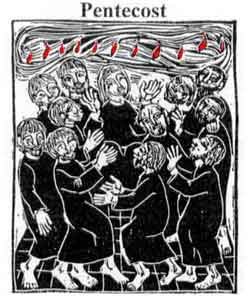
Daddy loved boxing, and baseball. I remember listening with him to the radio broadcast of the fight for the Heavyweight Championship when Rocky Marciano beat the World's champion Jersey Joe Wolcott. We listened to a lot of boxing matches and a lot of baseball games on the radio. In the summers, both my dad and my brother played baseball with our local team. Both of them pitched. And sometimes my dad was umpire. The whole town turned out for the games, except on the nights when the Pentecostal's held their church meetings. Then, a few friends and I would sneak away from the game and look in the windows at the people inside singing and praying and sometimes speaking in tongues.

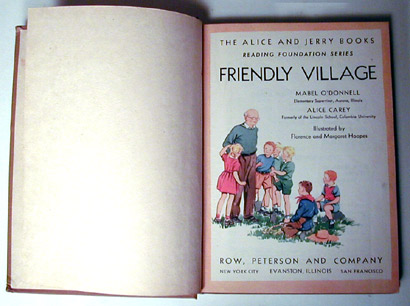
FRIENDLY VILLAGE


Even now it seems as if I remember the words that begin this book: I know a village where you would like to live. I would like to live there, too. The streets run up hill and down hill...and there are flowers in every garden." That may not be exactly right, but it's very close. The book recounted the adventures of Alice and Jerry. I think there was an old man named Ned. One chapter toward the end of the book told of blueberries growing by the sea. The boy actually gathered blueberries. I dreamed of blueberries, I longed forblueberries, I lusted afterblueberries. Many many years later, when I finally did taste a blueberry, it was a big disappointment. There is a lesson to be learned here. If you find it, you win -- a box of -- you guessed it -- blueberries!

FIRST READER


I can see them standing politely on the wide pages
that I was still learning to turn,
Jane in a blue jumper, Dick with his crayon-brown hair,
playing with a ball or exploring the cosmos
of the backyard, unaware they are the first characters,
the boy and girl who begin fiction.

Beyond the simple illustration of their neighborhood
the other protagonists were waiting in a huddle:
frightening Heathcliff, frightened Pip, Nick Adams
carrying a fishing rod. Emma Bovary riding into Rouen.

But I would read about the perfect boy amd his sister
even before I would read about Adam and Eve, garden and gate,
and before I heard the name Gutenberg, the type
of their simple talk was moving into my focusing eyes.

It was always Saturday and he and she
were always pointing at something and shouting, "Look!"
pointing at the dog, the bicycle, or at their father
as he pushed a hand mower over the lawn,
waving at aproned mother framed in the kitchen doorway,
pointing toward the sky, pointing at each other.

They wanted us to look but we had looked already
and seen the shaded lawn, the wagon, the postman.
We had seen the dog, walked, watered and fed the animal,
and now it was time to discover the infinite, clicking
permutations of the alphabet's small and capital letters.
Alphabetical ourselves in the rows of classroom desks,
we were forgetting how to look, learning how to read.

--Billy Collins, "Questions About Angels"

.

June Allyson & Me


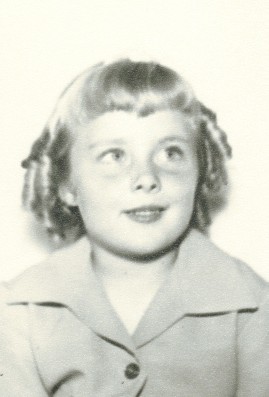
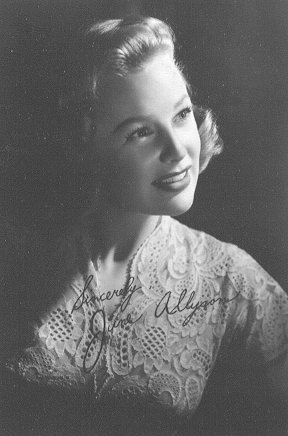
America's Sweetheart, June Allyson, has died at 88. I feel I must say something about her death, since I fell deeply and irrevocably and eternally (as much as a person can, at the age of seven) in love with her. I had just seen Little Women, in which she played the role of Jo. I was totally charmed. In all, she made 25 movies for MGM. Her "perky wholesomeness," her husky voice, her cheerful smile, her eyes, made her famous. Those eyes. How they glistened when she wept. How they sparkled and crinkled when she laughed! I wrote her a letter, detailing my love for her, and she sent me an autographed photo of herself. (One of thousands, I'm sure, but I didn't know that then.) I returned the favor by sending her a picture of me, this one. I found out that her birthday was on October 7th, and I sent her a necklace paid for from my own stash of money. (This gift went unacknowledged, but my love never waivered.) I haven't seen or heard of her in ages, I had almost forgotten her. Now she has died. RIP, June. You were one-of-a-kind!

Wednesday, August 30, 2006

Miss Dee


This, then, is a tribute to you, Miss Dee, wherever you are now. Miss Dee was a Jew, some people around town called her a Kike. Whatever, she was dark haired and beautiful and graceful, and every little girl in her dance classes loved her immensely. We all wanted to be just like her. Wherever she came from, suddenly she was here, in the middle of the Mojave Desert, to teach us how to be beautiful and graceful. We were like a flock of little brown birds in the presence of a Phoenix. Her real name was Mrs. Kahn. What was the "D" for? Delilah? Daphane? Diana? Deborah? I can't remember, but it must have stood for something more radiant and grand than our names: Norma, and Jackie, Virginia and Leonie, and Joyce.

There, in her little studio with its music, and barre, and mirrors, in the middle of all that dry sagebrush and sand, she taught us Acrobatics, Ballet, and Tap dancing. In our spare time after school we all practiced doing splits, and backbends and frontovers and cartwheels. We practiced tapdancing in our bare feet, in the sand. (Here I must tell you that my friend Leonie Kinikin also had a pair of ice skates, and we also used to ice skate in the sand! -- Our regular skating, with the skates clamped onto our shoes and fastened with a skate key was done on a big cement slab by Flossie's Variety Store).

Once or twice a year Miss Dee gave a recital, and our parents were invited to watch us perform. In Wisteria we were supposed to be a kind of lovely lavender flowers I had never seen. We were White Clouds drifting in a blue sky, we tapped out patriotic rhythms in sparkling Red, White, and Blue. Leonie and Norma danced Sunset and Night, where Leonie's beautiful many-colored costume was at the end, covered in Norma's black cloak. Oh, I can't begin to tell you how I envied Leonie's beautiful, filmy, pink and gold and scarlet colored dress, as Joseph's brothers must have envied and coveted his coat of many colors! I would have thrown her into a pit for that dress. I would have sold her into Egypt.

You see, Miss Dee, I remember this, even now! And though I know you will never see this, I want to tell you, Thank you, thank you, thank you, for sharing your grace and your talents with some little girls a long time ago in the middle of a great desert. You were an oasis in a wilderness.

Watch Me Grow


Tuesday, August 01, 2006

Me, Myself, and I


"The morning breeze has secrets to tell you.
Do not go back to sleep."

--Rumi


What secrets did the morning breeze of my early childhood tell me? That childhood is bliss. That the universe is a friendly place, full of love and kindness. That, as the poet Rumi wrote, we have been in heaven, we have been friends of the angels. And now we are here to discover our selves. Our consciousness expands in every direction, and what we intend to create, and what we desire, is on its way.* The Talmud says: Every blade of grass has its angel that bends over it and whispers, Grow, grow. So does an angel bend over me. And you.

*Dr Wayne Dyer

The morning breeze has secrets to tell you
Do not go back to sleep.

You must ask for what you really want.
Do not go back to sleep.

People go back and forth across the doorsill
where the two worlds touch.

The door is round and open.
Do not go back to sleep.

Tuesday, July 11, 2006

Little Boy Blue


The little toy dog is covered with dust,
But sturdy and staunch he stands;
And the little toy soldier is red with rust,
and his musket moulds in his hands.
Time was when the little toy dog was new,
And the soldier was passing fair;
And that was the time when our Little Boy Blue
Kissed them and put them there.

"Now don't you go till I come," he said,
"And don't you make any noise!"
So, toddling off to his trundle-bed,
He dreamt of his pretty toys;
And while he was dreaming, an angel song
Awakened our Little Boy Blue--
Oh! the years are many, the years are long,
But the little toy friends are true!

Ay, faithful to Little Boy Blue they stand,
Each in the same old place--
Awaiting the touch of a little hand,
The smile of a little face;
And they wonder, as waiting the long years through
In the dust of that little chair,
What has become of our Little Boy Blue,
Since he kissed them and put them there.

--Eugene Fields

I had memorized this poem from one of my books by the age of five. I loved it, I loved the picture that illustrated it. A book I have now lists it among other inferior poems because it is sentimental. "It oversimplifies," says the book. "It is unfaithful to the full complexity of human experience. It aims primarily at stimulating the emotions directly rather than at communicating experience truly and freshly; it depends on trite and well-tried formulas for exciting emotion; it revels in old oaken buckets, rocking chairs, mother love, and the pitter-patter of little feet."

Well, okay. It may not be listed among the very greatest of poems, but it was just right for a five-year-old who was still very into rocking chairs and mother love.

Thursday, June 22, 2006

Tumbleweeds


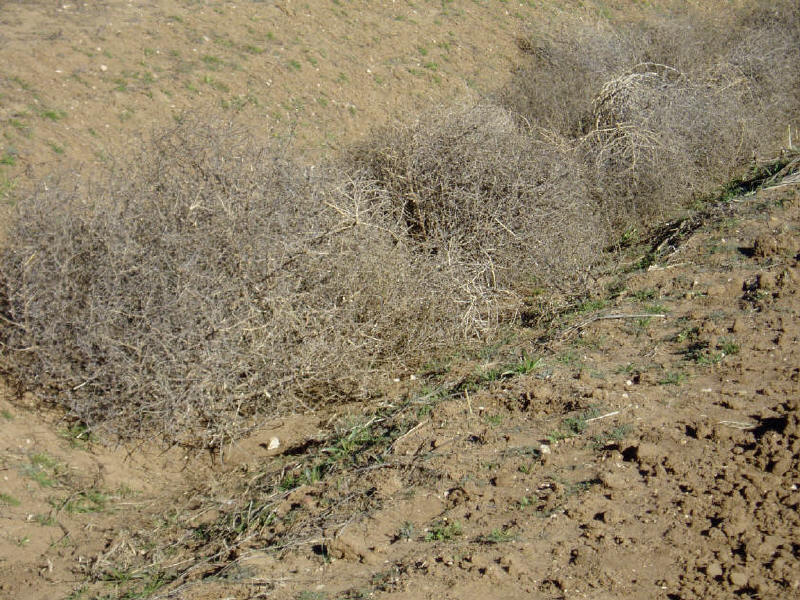
When I was a child, I would curl up in bed under three blankets, covering my ears against the wind howling outside. We could tell, by wind-clouds piling up along the tops of the Sierra-Nevadas, when there would be a big blow. The wind always came from the west, blowing sand into waves of dunes in the front yard, settling a fine, thick silt on the window sills and in the corners. It made spooky howling noises in the stovepipe and the clanging of the chains on my swingset against the bars kept me awake all night. As I looked out my bedroom window, the red light from the Penny Arcade sign across the street bloodied every grain of sand, turning the whole window red. Sand blasted the paint off cars and pitted windshields, and blotted out the sun. It stung our eyes and textured our dinner and turned tumbleweeds into flying missiles.

Once, the circus came to town in the middle of a terrific windstorm. Their Big Top swayed and groaned, the ropes and posts and canvases snapped like ships in the blowing sand. The daring young men on the flying trapeze may have been daring, but they were not fools, so they stayed safely on the ground while their swings billowed and lifted without them. Still, we saw monkeys (One, wearing a little red coat with gold buttons, bit my finger, outstretched in friendship. I never tried that again!) and elephants, lion-tamers and clowns. We saw Bambi-the-Snake-Woman, and Bobo-the-Dog-Faced-Boy. The Man-Turned-to-Stone invited our hands to feel the vibrations on his leg while he spoke. A nine-foot giant mummy, leathery and brown, reclined in a wood-and-glass case. Beside him in a smaller case there was another mummy of an ancient infant that looked like a little shriveled, brown monkey. We ate pink spun-sugar cotton candy, and shiney, red candy apples-on-a-stick.

And I remember once, Gypsies camped their tents and wagons at the far end of our lot. Someone said Gypsies stole children, dyed their skins brown with the juice of berries and walnuts, and they had to be Gysies for the rest of their lives. I lived in
horror they might kidnap me, yet I secretly hoped they would, so that I could live a life traveling in tents, wearing gold earring and bracelets up to my elbows, and dancing to the music of tambourines. However, I took the long, round-about way to school for as long as they camped there. I never heard one tambourine. The closest I ever came to living like a Gypsy was years later when I travelled around the country with a theater reperatory troupe--in a tan station wagon overflowing with old show programs, candy wrappers, banana skins, etc., and we made our own peculiar music (of a sort). In school every morning, the teacher gave us mimeographed pictures to color of Farmer Brown, Farmer Brown's Wife, and Farmer Brown's Boy Bill. (Never once Gypsies!)

I remember the hills and gullies full of sage and creosote and cactus, coyotes and rattlesnakes and lizards. When more and more people began to move in, they all vanished. The shrill night howling of coyotes used to send shivers of fear up and down my back. Now most of the remaining coyotes are pacing up and down in zoos, although the sheepmen say some still attack and kill their sheep. I suffer with the sheep, but my heart is with the coyotes. I think the whole history of creation is in those sheep and the coyotes.

Tuesday, June 20, 2006

Grandpa in Flowers


For tho' from out our bourne of time and place
the flood may bear me far,
I hope to meet my pilot face to face
when I have crossed the bar.

--Tennyson


James William Hatton
12/14/1878 - 12/13/1944

SO IT GOES!


I like to think of people as Kurt Vonnegut's Tralfamadorians saw them in Slaughterhouse Five,--as continuous beings not unlike long caterpillars, with fat baby's legs at one end, and long, ancient legs at the other--beings forever all-one-piece, integrated and entire. Vonnegut's Tralfamadorians, seeing into the fourth dimension, perceive the universe in a radically different way:

"All moments, past, present, and future, always have existed, always will exist. The Tralfamadorians can look at all the different moments just the way we can look at a stretch of the Rocky Mountains, for instance. They can see how permanent all the moments are, and they can look at any moment that interests them. It is just an illusion we have here on Earth that one moment follows another, like beads on a string, and that once a moment is gone it is gone forever.

"When a Tralfamadorian sees a corpse, all he thinks is that the dead person is in bad condition at that particular moment, but that the same person is just fine in plenty of other moments. Now, when I myself hear that somebody is dead, I simply shrug and say what the Tralfamadorians say about dead people, which is 'So it goes!'"


So it goes. I am five-years-old, and they have taken me to say "goodbye" to my grandpa, who is sleeping in flowers, but he doesn't wake no matter what is said to him.

Then I am six-years-old, having another encounter with Vulture Death. I hold a brown leather dog collar. Topper was a good dog, now he is dead, run over by a truck. The truck meant no harm. The driver was sorry, and he said so. I think of all the uncounted dogs and cats and birds that died somewhere back in my childhood: Sparky and Cue-Ball, Topper, Lucky, Penny and Bobby, blue and green parakeets, Monday the sparrow, Perry the chipmunk....a boxfull of naked pink baby mice someone found in an old trunk and brought to me. Another sparrow we named Frosty. Toots, and Queenie, the last dogs of my childhood. When Topper died, for weeks afterward the very air smelled of him. He was nowhere and everywhere. And every loss brought floods of tears. When Lucky died I wrote my first poem:

There is no more puppy
to laugh with, or play.
There is no more puppy
to care for each day.

There is no more puppy
to come when I call,
there is no more puppy,
no puppy at all.

Well, it's not Shakespeare, but what d'you expect? I was eight.

Back to Vonnegut's caterpillar. I am six again, watching snakes climb up the gray folds in the window-curtains, hearing the old photographs on the walls whisper to one another of times past in quiet, paper voices. My heart thumps monstrously loud.

Whatever happened to Baby Dumpling, and the rocking chair, and all those pop bottles full of sand? Nicodemus had no shoes, so who was it stepped in all the pies? Jesus loves me, this I know. I'll be a sunbeam for him. I love Jesus. I love cats. Cue-Ball is my cat. He rides in the little buggy and sings. A sunbeam, a sunbeam, Jesus wants me for a sunbeam. Loves. By pinching is how people who love each other very much get babies.

I was stunned when mother told me how people do get babies. "Do you remember that word I told you not to say?" Mother must have been acutely embarrassed. "That's what people do." She never said the word, but that was my sex education. I knew those bizarre activities occurred, whatever they were called. But I could not imagine why anyone would want to do such things, and certainly, if they did, it didn't concern me. We never talked about "it" again.

So it goes!

Wednesday, June 14, 2006

THOSE TIMES


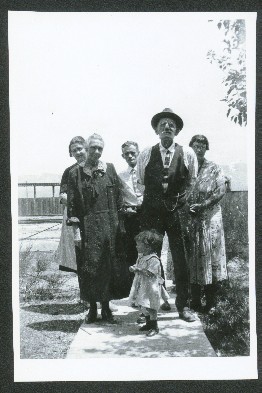
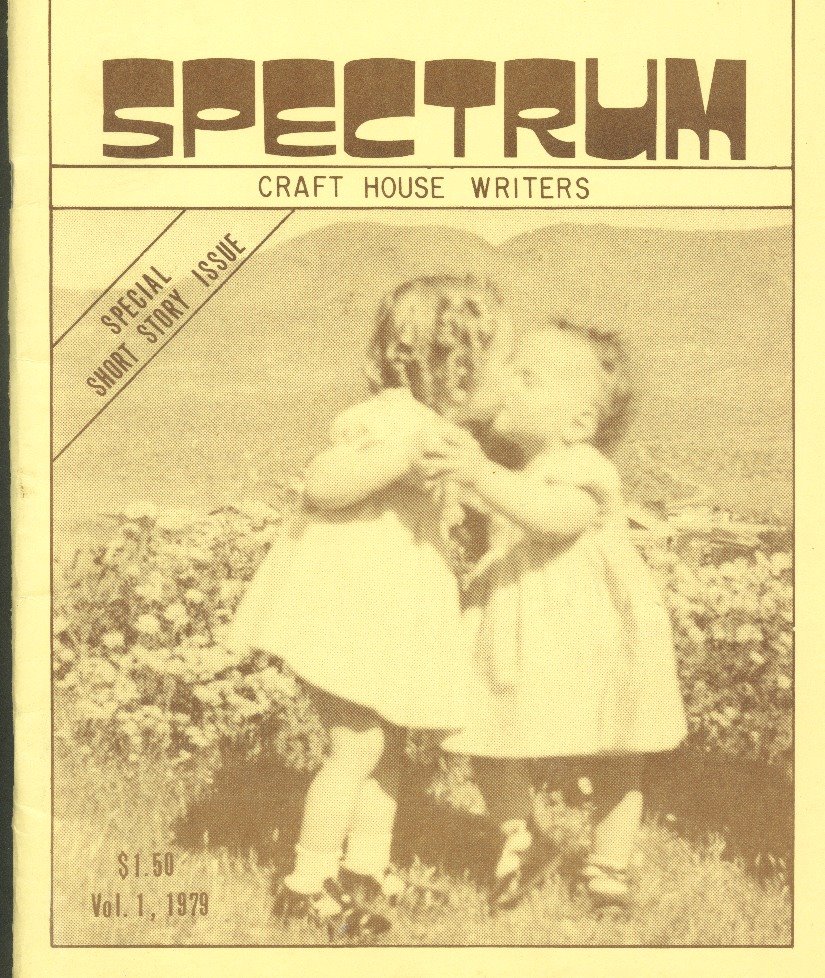
Diane and me, in wildflowers. Riding in a baby carriage, being angry, bawling that my friend Diane (being littler) was sitting comfortably in the shade of the hood while I was at the end, in the sun. The carriage was being pushed by someone named Virginia.

Riding on my dad's shoulders down the hill in the dark to get ice-cream, and returning home to find Santa Claus had come. He left a set of little blue plastic dishes, and my beautiful Baby Sunshine baby doll. She was also called, sometimes, Baby Dumpling--(after the real baby of a friend of my mama's--actually, Blondie and Dagwood's first baby Alexander was called 'Baby Dumpling,' so that's where it all started, in the funny papers!)

Playing with my mother's old dolls, a blue celluloid baby (which I left outside to be ruined--(all her arms and legs fell off), and another of her dolls which I loved, with a china head, real hair, and a smile with real teeth--(which I also left outside for the dog to ruin). She was my mother's, when she was a little girl. The doll's name was 'Norma,' and she still resides (her china head glued back together) in a box in my attic.

I remember playing in Bacopickle's garden, the fence, the hollyhocks. I always carried a big smooth oval rock around, pretending it was my 'baby.' John, Bacopickle's husband (but never my 'grandpa') once sent me a letter (an exciting thing!) telling me to 'be a good girl,' and to 'go sit on a tack,' or maybe it was 'don't sit on a tack.' Whichever, I was pleased and thought it was funny. John always called me "Blondie."

A watermelon 'bust' at Dry Lake. My cousin Jerry and I kick sand on the campfire to put it out. The big people heap praises upon us. We kick more sand on the fire. I am going to marry Jerry. Jerry kicks a big desert turtle on the top of its shell with the heel of his boot. How mean! I am not going to marry Jerry after all.

My brother's black dog, Sparky. My brother jumping over a fence, followed by Sparky. I remember looking for Sparky after he was poisoned, suspecting that he was buried under a red hill of dirt in the yard, digging to find him.

My old black-and-white tomcat, Cue-Ball. I dress him up in doll clothes and haul him around in my wicker doll-buggy. He is docile and loving and content. He lays on his back and purrs, wrapped in a little blanket. Sometime later, I am sitting on my Grandma Bacopickle's lap in the big rocker. Cue-Ball is on my lap, purring, his claws pushing in and out like cat's do when they're happy. One of his claws catches a big scab already on my knee and pulls it off. The knee becomes infected, and we go to see Dr. Drummond (the doctor who delivered me), where his pretty nurse, Cherry, fixes me up with a new bandage. I remember my crib, metal with white, peeling paint. Every time I walked by it I knocked the scab off my knee! I slept in the crib until I was four or five.

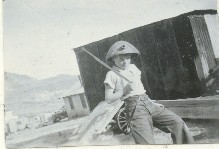
I remember going on vacation, a picnic of sorts. I need to go potty and I'm taken out to a private wooded place. Later on, I discover my privacy was invaded--someone took my picture! I feel betrayed and humiliated. I am enraged and embarassed seeing these two photographs, "hoarding my small dignity," as Anne Sexon wrote in a poem called THOSE TIMES.

We are in Whitney, Nevada, where my dad is thinking of buying a store with my Uncle Leffel. I find a nest of kittens, one dangling by its neck between two shelves under a counter. In Whitney, I make a 'cradle' of my hands to rock a tiny baby turtle, (a fingerplay mama taught me): Here are mother's knives and forks, here is mother's table. Here is sister's looking-glass, and here's the baby's cradle. We leave Whitney after a short time and come back to California. (My brother, who was 14 at the time, informs me that there was a big magnesium mine that opened up, and since it was wartime, there was a great demand for magnesiuim. Dad and two of our uncles, Leffel and Ray, thought a store would be a good idea. We stayed there for only six months, so it probably wasn't.)


Someone holds me up to peer over a high fence where a little girl who has no arms plays. They tell me how she can feed and dress herself, and write, anyway, with her toes. I am impressed. Someone holds me up to a window, where a sick girl named Yvonne is darkly quarentined behind a screen. Say "Hello," I am told. "Hello," I say, but I feel something dark inside my chest that I can only equate now to Defoe's Journal of the Plague Year.


The sound tin cans made when they were scraped in the sand. Filling up empty bottles with the sand, patting it down flat when they were full. The taste of sand, the wonderful smell of it. Pouring it out, and scooping it up again.

Making 'pets' out of the little white balls of fuzz that grew on the creosote bush beside the house. In the summer, they turned, like dandelions, into tiny yellow flowers. The smell of wildflowers in the spring. The hillsides were covered with wildflowers.

The tobacco-smell of my grandpa. The powder-smell of Nanny.

Outhouses. Grandpa and Nanny had a seat with a lid on theirs. Ours was just a hole in a board. My little potty chair inside, by the ice-box. My little rocking chair.

My butcher-boy outfit with flowers embroidered across the front. My coat with little buttons shaped like deer.

The 'bean' tree in our yard, a locust tree, I think. I gathered the long, thin green pods and 'cooked' them.

I remember seeing a movie cartoon where Mickey Mouse cut a loaf of bread into slices so thin they were transparent. You could see the knife passing through.

Biting the skin on my mother's elbow because it felt so good to my teeth. --Never hard enough to hurt, but it must've been really annoying to her....

Misunderstood! I am standing in the front seat of the car, between Mama (who is driving) and Mrs. Lambly, (who is all dressed up) and who has white hair and shiney dangling earrings. I admire her earrings, am about to touch them, when mama scolds me, tells me to "stop it." I realize that she thinks I will pull them through the piercings in the lady's ears. My feelings are hurt that she thinks I'd do something so stupid. I just thought they were pretty things, and I was going to tell her so.

The rusty water towers on the hill above our house. The silver milk cans in the barn. The way the cream wrinkls on top of the milk.

Rinaldi's Meat Market; It smells of the thick sawdust covering the floor, ankle-deep, and of salt. I like to come here with my mother. The earthy smells of the mine shafts daddy works in, of the burning carbide in the miners' lamps, of cool wet rocks.

All of these before I was five, before we moved away from Red Mountain.

Sunday, June 04, 2006

THE BOMB

Praise The Lord


And Pass the Ammunition


Down went the gunner; a bullet was his fate,
Down went the gunner, and then the gunner's mate.
Up jumped the sky pilot, gave the boys a look
And manned the gun himself as he laid aside the Book,
Shouting: Praise the Lord and Pass the Ammunition!
Praise the Lord, and Pass the Ammunition!
Praise the Lord, and Pass the Ammunition,
And we'll all stay free!

Praise the Lord, and swing into position,
Can't afford to sit around a'wishin'.
Praise the Lord, we're all between perdition
And the deep blue sea!

Yes, the sky pilot said it. You've got to give him credit,
For a son-of-a-gun of a gunner was he, shouting:
Praise the Lord; we're on a mighty mission,
All aboard! We're not a'goin' fishin'.
Praise the Lord, and Pass the Ammunition,
And we'll all stay free!


Words and Music by FRANK LOESSER

WW2, Three Musketeers


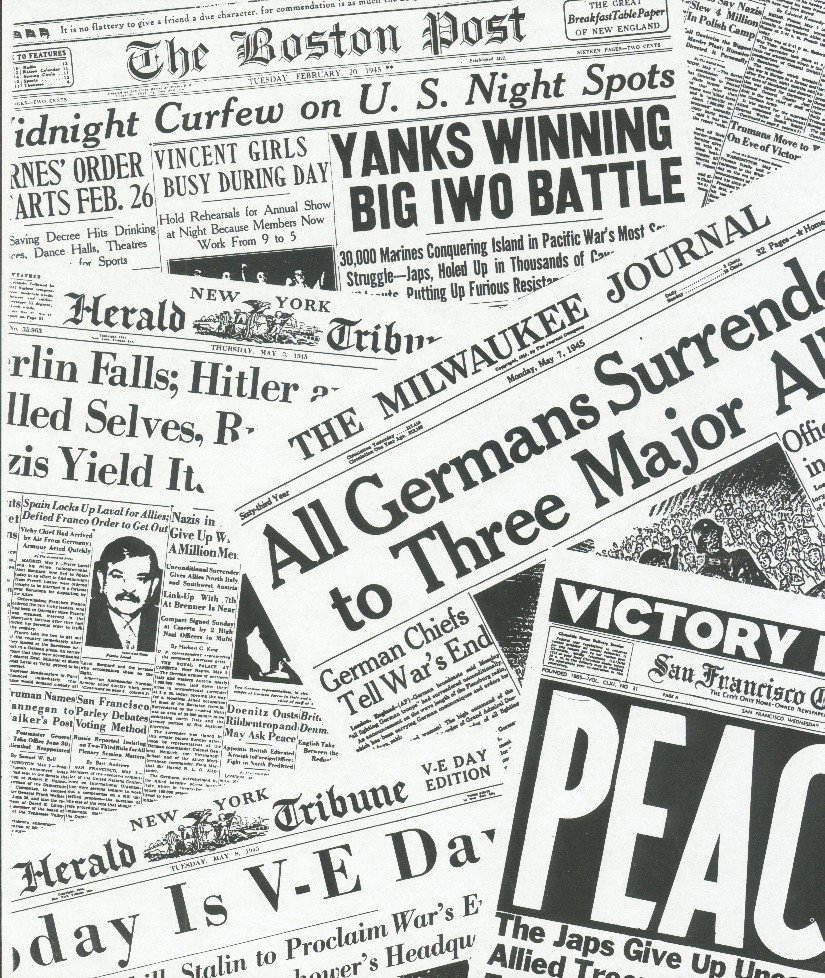
On December 7, 1941, the Japanese bombed Pearl Harbor Naval Base in Hawaii in a surprise attack, killing some 3,000 Americans. I actually remember people weeping, whispering those words, "Pearl Harbor!" Within days, young Americans flocked to enlist in the service, among them my dad's curley-headed brother, my Uncle Rulon. He spent most of the war years in (of all places), Iran. Daddy joined the Coast Guard. Tommy Dorsey recorded "Kiss the Boys Goodbye." The Andrew Sisters sang about the "Boogie Woogie Bugle Boy." In the years that followed, clocks were turned ahead one hour as "war time," now called Daylight Savings Time, went into effect. Gasoline, sugar, and butter were rationed. People carried little packets filled with "tokens," little round brown things that could be spent as money. Mama filled plastic trays with a white margerine and poured in little packages of yellow dye to make it look like real butter. Even the movie stars went to war. Clark Gable, Jimmy Stewart, Gene Autry, Spencer Tracy, and Douglas Fairbanks joined up, while glamorous women stars asked us to buy war bonds. "Praise the Lord and Pass the Ammunition" was number 1 on the Hit Parade. I stood on some piano bench, somewhere, and sang it to much applause. (The end of my singing in public, I might add!) Mama sang in the kitchen, while fixing dinner and doing dishes, she sang as she made the beds, and swept the floors. Ac-cent-tchu-ate The Positive, E-lim-i-nate the negative. Don't Get Around Much Anymore. I'll Never Smile Again. I'll Be Seeing You in All the Old Familiar Places. The Last Time I Saw Paris. She sang Sentimental Journey, and You'll Never Know Just How Much I Love You, You'll Never Know Just How Much I Care.... These songs became part of me, and I knew all the words. Oh How I Hate To Get Up In The Morning. I dropped little rocks on ants, playing "Bombs Over Tokyo," and I knew how to draw a swastika with my finger in the dirt. Hitler's face, and Tokyo Joe's were everywhere. They're Either Too Young or Too Old, They're Either Too Gray or Too Grassy Green! The Pickin's is Poor, and The Crop Is Lean....

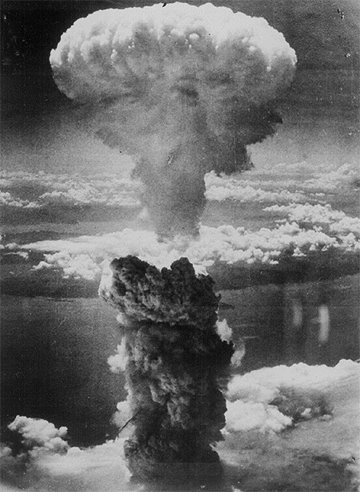
Then President Roosevelt, who so often spoke to us over the radio, died. Mama cried, and stopped singing. We dropped an Atomic Bomb on Hiroshima and another on Nagasaki. We stormed the beaches at Normandy. The war was over.

They continued to perfect the Bomb. Even after we moved from the yellow house Daddy built in Red Mountain to the house with a bird's nest in the chandellier in Inyokern, they continued to test the Bomb in Nevada. We got out of our beds early in the morning on the day of the test, stood in our front yard, and watched as the red cloud rose over the east mountains. We could see it all the way in California. And we could hear, and feel, the rumble of the shock wave several moments after.

People began to worry about the "T-Zone" in their cigarettes, Taste and Throat, and they would "Walk a Mile for a Camel." There was "Never a Rough Puff in a Lucky," and the old 'ice-box' became a thing of the past when we bought a new refrigerator. Campbell's Soup was "Mmmm-Mmmm Good!"

There were "real" faces and "friendly" faces. "Real" faces belonged to Harry Truman, and Estes Kefauver, and Clement Attlee, to Bing Crosby and Bob Hope, to Dorothy Lamour and Betty Hutton. Although some of these faces were also "friendly," I paid more attention to other faces I loved: Sniffles and Mary Jane, Marmaduke Mouse, Little Henry, the Little King, and Little Lulu, with her black ringlets, her cheery smile, her red dress, and her olive-black eyes.

Now cigarettes are politically incorrect, they'll give you cancer and bad breath, and their secondhand smoke will kill you. And Sniffles and Mary Jane, along with all those other "friendly" faces have gone the way of the dinosaur and the dodo bird.

Sunday, May 21, 2006

A Lamb's Tail


When Daddy left for work every day, he'd give Mama a peck on the lips and she'd always say, "Be careful, and don't work too hard!"

And he'd say, "I'll be back in two shakes of a lamb's tail!"

I guessed that meant quickly, as, in a flash. Hmmm.

This one is short, so you can read it quickly, in two shakes of a lamb's tail, and go on about your business.

Don't You Forget it!


"Epamanondas, you don't have the sense you were born with. But I love you just the same, and don't you forget it."

And he never did.

About Me

My photo
1. In dreams I am often young and thin with long blond hair. 2. In real life I am no longer young, or thin, or blonde. 3. My back hurts. 4. I hate to sleep alone. (Fortunately I don't have to!) 5. My great grandfather had 2 wives at once. 6. I wish I had more self-discipline. (I was once fired from a teaching position in a private school because they said I was "too unstructured and undisciplined." --Who, me??? Naaaahhh....) 7. I do not blame my parents for this. Once, at a parent-teacher conference, the teacher told me my little boy was "spacey." We ALL are, I told her. The whole fan damily is spacey. She thought I was kidding. I wasn't. 8. I used to travel with a theater reperatory company. My parents weren't happy about this. 9. My mother was afraid that I would run off and paint flowers on my cheeks and live in a commune, and grow vegetables. I once smoked pot. ONE TIME. 10. I don't drink or smoke. (Or swear, much. Well, I drink milk, and water, and orange juice, and stuff. Cocoa. I love Pepsi.) 11. Most of my friends are invisible. 12. I am a poet and a writer. All of my writing on these pages is copyrighted. Borrowing (without acknowledgment) is a sin.